I'm starting to prepare my much-anticipated report on the state of the Second Life economy for 2025 — a follow-up to this report from last year — and it will include an anonymous survey sent to SL merchants.
Below are the questions I'm planning to ask. Are there other burning queries I should include?
Cajsa Lilliehook covers the best in virtual world screenshot art and digital painting
While browsing all the Happy Easter pictures of friends and relatives with their kids hunting for eggs and the laden tables of Easter dinners, I thought it was a good idea to see what Second Life residents had to offer. Second Life Easter was much more interesting, if I do say so myself. Leonorah Beverly’s “Happy Easter” is not quite in sync with the usual pastel sweetness you usually see, but that makes it interesting. I love that she takes such a departure from the expected. It is a fun picture.
Bumped up for weekend watching and discussions. Originally published on my Patreon
SL YouTuber Prisqua Newall and Hari Sutherland (author of Second Life's first coffee table book) recently invited me to have this fun debate (watch above!) about ideas for growing the user base of our favorite virtual world. We touch on a number of strategies, variations of which have been tried before (including themed welcome areas).
Somewhat hilariously, we end up agreeing on one that hasn't yet been tried: Pay people to join Second Life. Or more specifically, give YouTube/Twitch/TikTok etc. influencers an affiliate cash reward for getting their followers to become SLers over a certain period of time. There's already a number of influencers who stream SL along with other virtual worlds. (One, Carmen King, has over 1 million followers.) Their fan bases already have an incentive to join them in-world for fun events, and because their stock in trade is live video, they can help these new users get over the various tech/UX hurdles they'll inevitably come across. So it's definitely worth trying!
My own focus is on presenting/marketing Second Life as a sandbox sim game, to go after the people who already play similar virtual worlds/sandbox games. As you can see by the adamant viewer comments in the YouTube video, the term "game" rubs many the wrong way.
"[We’re] still debating what Second Life actually is," as Prisqua puts it. "And judging by the comments on my channel, people are really offended by it being called a game … like, passionately so."
It's totally fine that many (if not most) users refuse to call Second Life a game. I suspect we're dealing with an unbridgeable generation gap, not of age, but experience — those who grew up with online games already know they're also a special kind of social/community space where real relationships are fostered and formed. Those who did not tend to see games as being trivial or kids stuff and definitely not worth their time, so take personal umbrage when Second Life is branded as one.
All that to one side, the fact remains: By refusing to market/present Second Life as a kind of sandbox simulation game, Linden Lab is giving up on the easy opportunity to grow the user base by many millions of users who are already intimately familiar with similar products, i.e. gamers. (Second Life still not being on Steam being the most obvious example of that sin of omission.)
Anyway, here's Prisqua and Hari's takeaways from this chat:
Cajsa Lilliehook covers the best in virtual world screenshot art and digital painting
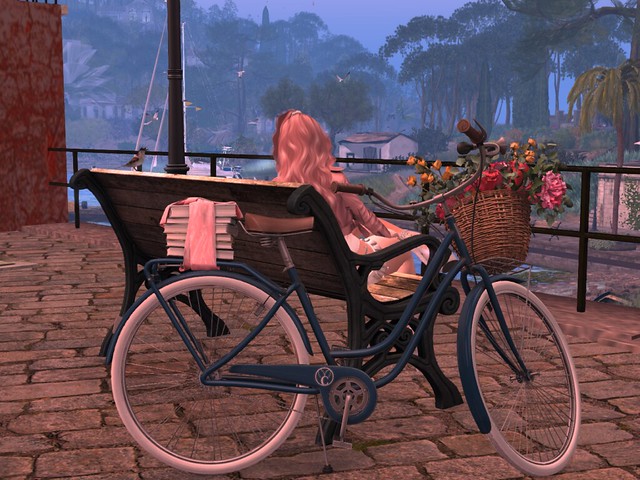
∞ (yes the infinity sign) is a new-to-me account whom I discovered in Vyka Coy’s favorites in this third, and last, leg of the FaVes Game. She is someone who documents her life in Second Life. Her stream has no other purpose other than showing her friends, her home, her travels, and sharing her joys. Sometimes it seems that we are all taking pictures with a secondary purpose from vendor ads to blogging features to art projects. ∞ is taking pictures for the fun of it, sharing her life with us. I love this picture. The bike is so romantic with the stack of books and gathering of flowers. She’s taking a break, looking at the traffic on the river. I can’t wait to see who is in her Favorites.
I've asked this before, but here I go again: What's the point of prompt-based world building, when we already have many multiple 3D building tools which are user-friendly, feature-rich, and, well, fun? This point must be repeated, since Meta is currently promising we can build faster and smarter with GenAI Tools in Meta Horizon Worlds:
Today, we’re excited to follow up on that commitment by expanding access to the desktop editor and its GenAI tools into the UK and Canada in addition to the US. These tools dramatically reduce development time from weeks to as little as hours; accelerating the ability of creators to translate their visions into high-fidelity worlds that users love.
Watch the demo above. It makes me wonder if anyone at Meta has ever watched a speedbuild video before. Because here's one from a Sims 4 user who's not only building about as fast and with the same quality output, but enjoyably chatting as she does:
The cardboard avatars of Salt Pepper have already evolved from an April Fool's prank into a social phenomenon; now, I can report they're also an economic powerhouse in Second Life. The PMR and accessory skin have been among the top ten selling items on the Marketplace since last weekend (see below), their lo-fi displays a refreshing contrast to the super model avatar upgrades which usually dominate the economy. (And culture.)
Even more notable, PMR creator Salt Pepper tells me, the cardboard avatars continue to be popular even though she's no longer offering them for free. Now priced at L$555 (about $2 USD), Salt tells me she's sold well over 2000 copies over the last few days.
Just as notable: PMR is having its first sales event/hunt this weekend, starting April 19th at 3PM SLT, inevitably dubbed: Flat-Out Fun.
Hosted by Novel Events (follow on Facebook for updates), it comes with its own flat paper-based town in Second Life, quickly created by Alice Tartaglia:
In our definition, Specialized virtual worlds fall roughly into this category:
Virtual worlds primarily created for Education/Training, Meetings, or other Enterprise use cases — or social worlds with limited access due to narrow usage or limited platform / geographic availability, or other barriers to entry.
So for example, Breakroom falls in the Enterprise category, while ZEPETO falls in the latter category, as it's a social virtual world that's mobile only, and mainly used/marketed to a South Korean user base.
See the (mostly) whole list below. We're also adding open source virtual worlds to this category, but that'll be in the next edition.
Cajsa Lilliehook covers the best in virtual world screenshot art and digital painting
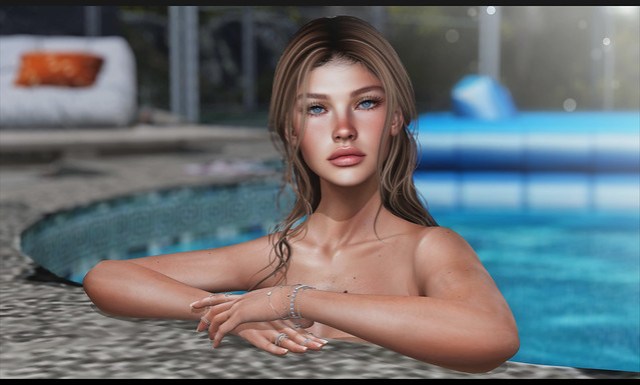
Tabitha Schnyder is a new-to-me discovery in Wind Moonstone’s favorites. I ended with Wind in yesterday’s column with the first installment of the Faves Game. Tabitha is a fashion blogger. I like this picture of her. The wet hair is a nice touch. When I began in Second Life, swimming pools, lakes, and oceans had this uncanny ability to keep your hair dry. It was kind of like the rain in Oregon in which you can walk about for an hour without getting wet.
Here's the results of last week's Gen AI survey, which I took in the run-up to Second Life's official "AI & the Future of Our Virtual Community" town hall happening this Friday.
The results are pretty unambiguous: A massive majority of over 85% surveyed want some kind of regulation against gen AI-made content in the SL Marketplace, with a majority (54%) choosing this option as the one they agree with most: REQUIRE merchants tag their content as having "No AI" or "Contains AI". (Presumably this would be self-enforcing by the user community)
I reached out to Linden Lab for their commentary on these regulatory options, and they told me they'll include these survey results in their upcoming AI town hall. I'm told the event will probably not include any new announcements, and is more of a user feedback session — and, well, this survey is that.
Given the heat and controversy over the topic, I'm actually somewhat surprised that was the most preferred option. By contrast, only 1 in 4 chose the most draconian option: BAN all Marketplace content that contains generative AI, enforced by Linden Lab staff (23.8% chose that). Maybe few chose this for technical reasons: my impression is it would be highly difficult if not an impractical lost cause to scan content for suspicious signs of gen AI, which is probably why few respondents chose this option.
It's also in keeping with the community's values around player choice. As an anonymous reader put it somewhat sardonically:
 Wagner James Au / New World Notes