
Sanny Yoshikawa が、New World Notesのなかから、毎月おすすめのバーチャルワールドニュースを日本語で紹介 します
Sanny Yoshikawa covers the monthly virtual world highlights from New World Notes for virtual Japan.
Sanny Yoshikawa が、New World Notesのなかから、毎月おすすめのバーチャルワールドニュースを日本語で紹介 します
Sanny Yoshikawa covers the monthly virtual world highlights from New World Notes for virtual Japan.
Last week's post on Dr. Ruth Diaz's new project to interview and better understand virtual world trolls helped provoke a pretty interesting reader conversation that's difficult to summarize, but here's one particular highlight — longtime reader Martin K. makes the provocative argument that trolls are somewhat necessary to the long term health of virtual worlds:
[T]rolling and toxicity might be important for many virtual communities to stay stable (and relatively small) by limiting the influx of new users (and thereby avoiding the "Eternal September" problem). I consider Second Life, VRChat, Rec Room, and Gorilla Tag examples of such communities.
By Eternal September, Martin's referring to a phenomena back in the early 90s when Usenet was opened up to mainstream Internet users, causing a backlash among the established user base of Usenet groups. In other words, trolling might have the effect of driving out noobs while maintaining stability and group cohesion among the dedicated community.
But how can a platform expand? Martin again:
The way to grow a community beyond those limits appears to be the fragmentation of a community into smaller groups ("bubbles") with limited communication between groups. Facebook has perfected this approach, but long before Facebook (and other social media), competitive team-based multiplayer games have strictly limited communication between competing teams to limit toxicity.
Whether social VR can adopt this approach of fragmentation to grow larger communities is an open question.
VRChat actually did keep growing its user base beyond the infamous Ugandan Knuckles troll era of 2017/2018 and now boasts over 10 million active users. That's largely a credit to the platform's karmic system (as I discuss in my book); arguably the fact that individual VRChat worlds tend to have a small capacity (20-30 is ideal) helped enable sub-communities to avoid both trolls and noobs.
Anyway, in response to Martin's argument, Samantha Venia Logan, a colleague of Dr. Diaz and herself a PhD candidate, makes some important distinctions:
Above: Dr. Diaz talks with someone who formerly trolled them
Cajsa Lilliehook covers the best in virtual world screenshot art and digital painting
Arualblues Zero has a blog called Second Laura that is my favorite kind of Second Life blog, one that gives us stories. Her recent post You Have Been Loved is quite extraordinary. Not only did she give us an older than average avatar, but an emotional vignette of an old man in his sickbed who wakes up in the night, feeling the weight of loneliness and fumbling “with heavy fingers” for the remote so he can distract himself. The picture and the story are so well done.
For more stories, click here:
Please follow my Patreon for free! And if you find New World Notes valuable, please consider subscribing! Members at the Supporter level ($5/month) get early/exclusive access to premium articles and a free Kindle copy of Making of Second Life, while subscribers at the Creator and Metaverse level ($50 or $100 month) get many additional benefits — including a prominent ad for your virtual world/metaverse brand on New World Notes, with 100,000/month visits and an audience highly interested in virtual world/metaverse content, especially Second Life!
//embedr.flickr.com/assets/client-code.js
Cajsa Lilliehook covers the best in virtual world screenshot art and digital painting
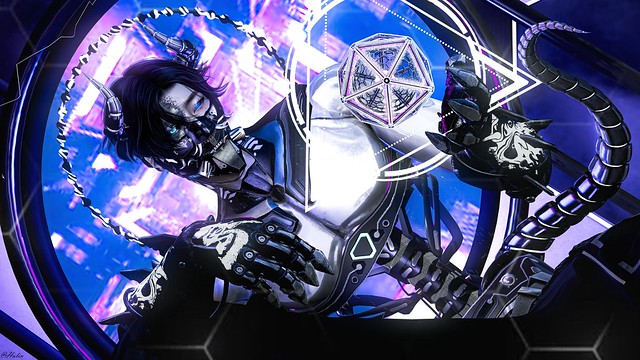
Lin Hexem has a love of cyber fashion and roleplaying and he shows cyber fashion at its best with fantastic pictures and styling. Take this picture “Artificial,” The background and lighting bring this picture to life.
For more fantastic future forward fashions, click here:

Originally published Monday on my Patreon
I just got detailed replies from Leticia Roncero Portas, Manager of Community at Flickr, in response to an email I sent to her and Flickr's CEO, asking about the recent rash of reported bannings and suspensions among the Second Life community who share images on the platform.
Contrary to what some SLers have asserted, she tells me, there is no concerted effort by Flickr the company to target Second Life users on the platform. In fact, she notes that Flickr has actively promoted the SL community in recent years:
"[W]e celebrated Second Life's 20th-anniversary last year (and have celebrated SL on multiple other occasions) on our socials and through our blog/newsletter," she tells me by example, noting that they even created a special membership promo for the celebration. "My team is constantly planning initiatives focused on this and other active communities that engage on Flickr."
Indeed, Flickr's original founders, Caterina Fake and Stewart Butterfield, were Second Life users themselves back in the day. (I was still at Linden Lab when one staffer shouted excitedly, "I saw Caterina and Stewart logged in!") The platform itself was first created in 2004 as a tool for a virtual world, called Game Neverending.
Now, Flickr the company is even crafting policies largely tailored to serve the SL Flickr community:
"[T]he Guide to Safety Levels for Nudity and Sexual Content–and the update on the Commercial Use Policy we're working on–are in part initiatives we took on to help Second Life members in particular (but not exclusively) navigate our Guidelines," as Portas puts it.
She estimates that there are "hundreds of thousands" of Flickr accounts are SL-related — which suggests quite a lot of the active Second Life user base also uses Flickr on a regular basis.
As for any increase in bans/suspensions, she tells me there is no heightened focus penalizing SL users on Flickr in particular:
 Wagner James Au / New World Notes