Writing about Udon Tycoon in VRChat last week, it occurred to me that I haven't covered a Second Life-based project of similar ambition and scope in a long time. (Beautiful sims, to be sure, we gotthat covered, along with light roleplay game experiences in SL.) But Udon Tycoon has user-created, physics-enabled, save-able coaster building that's rideable and instantiated in the same world at the same. Is there a recent SL project (say within the last 3 years) with roughly comparable inventiveness?
This is not a concern troll post, I'm genuinely curious — it's quite possible (as has happened many time before) that there's some amazing project quietly being built deep in the heart of Second Life that the creators don't bother to promote, since they're not concerned about publicity per se, and enjoy the creation as an act in itself. Which is great for them, but the world should know too. (Well, I sure would.)
Mic is open below — let me know! Please include links and contact info wherever possible.
Cajsa Lilliehook covers the best in virtual world screenshot art and digital painting
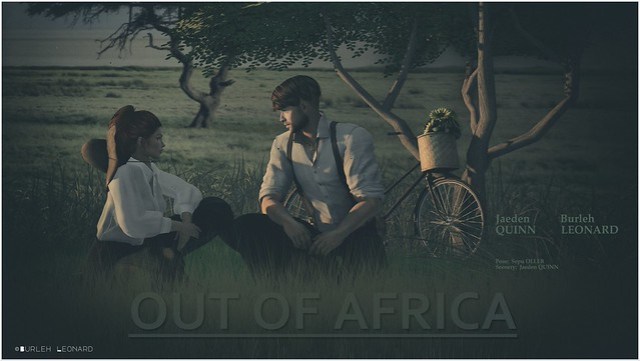
SL image makers, here's a fun challenge: Recreate a movie poster in Second Life, tag it #SLMovieTribute on Flickr, and I will choose some of my favorites to feature in an upcoming post. I'll also feature them on my Flickr in a a gallery. Deadline is November 15.
For inspiration, here's some previous examples.
Burleh Leonard (above) posted this fabulous homage to the movie poster from Out of Africa charmed me by not being an exact recreation. Instead he made the lighting darker as though the sun is setting. It is more subtle and screened the movie title so it fades into the grass. I like this so much better as it foreshadows the tragedy of the film so much more than the sun-drenched original.
Sanny Yoshikawa が、New World Notesのなかから、毎月おすすめのバーチャルワールドニュースを日本語で紹介します。Sanny Yoshikawa covers the monthly virtual world highlights from New World Notes for virtual Japan.
In the Atlantic, longtime Internet activist and scholar Ethan Zuckerman takes textual fisticuffs to Mark Zuckerberg's Meta and Metaverse ambitions, going through the long evolution of the technology like an avuncular Bane. ("Ah you think the Metaverse is your ally? You merely adopted the Metaverse. I was born in it, molded by it.") Because Ethan's hands-on history with the Metaverse started as a developer in the 90s, and features a long stop at Second Life:
When Linden Lab launched this metaverse in 2003, there was a brief burst of enthusiasm where otherwise serious entities, such as businesses and universities, bought and built out their own islands in Linden’s proprietary world. (Harvard’s Berkman Center for Internet and Society, now the Berkman Klein Center, had its own island.) The learning curve to build objects in Second Life was steep, the universe was populated haphazardly, and the Second Life client demanded a very fast computer and a very patient user. But pioneers in the space saw beyond these limitations and envisioned a system that was so emotionally compelling that journalists and activists would be forced to engage with it to reach audiences.
I was invited to the Metaverse Roadmap Summit in 2006 to see some of these “serious” Second Life spaces. The one that finally caused me to lose my shit was Camp Darfur, an exhibit designed to help metaverse explorers understand what Sudanese refugees were experiencing when they were displaced from their homes. Of course, this was Sudan as understood through the eyes of well-meaning Bay Area techies, which meant it featured a roaring campfire surrounded by wooden tree stumps where you could sit and contemplate the horrors of genocide. Given that women routinely walked miles from barren, tree-free desert camps to collect firewood, risking assault and rape in the process, it seemed like the sort of detail you’d want to get right in simulating the refugee experience.
I vividly remember Ethan losing his aforementioned shit on the topic, because I was onstage at the Metaverse Summit when SL's Camp Darfur project was discussed. (I first blogged about it here – pic of the notorious campfire above.) I was more interested in the group of Green Lantern roleplayers who protected the camp from griefers, but Ethan's objections to the project itself were painfully on point, a lesson in how easy it is for us to lose sight of what actually matters amid our ebullience over new technology.
UdonTycoon is a new VRChat experience [search “Udon Tycoon” to play] that’s easily the most amazing game I’ve seen created on the platform. (And I’ve seensome amazing ones.) Basically a mash-up of Roller Coaster Tycoon but in VR and in a multi-user virtual world, it includes a user-controlled toolkit that enables players to create and save their own rollercoaster tracks and — this part makes my head spin — share them in the same space with other players at the same time.
“Yes, it's all fully networked,” lead creator Reimajo tells me. “[Players] can even preview the parts that other users intent to place with them.”
Reimajo and her collaborators have been building this in their free time for over a year, coding gameplay (as the name suggests) in UdonSharp, the user-made C#-to-Udon compiler popular with VRChat developers. But at first, she didn’t even intend to turn it into a full-fledged game: “[W]e just worked way too long on some things that we personally found cool because nobody else had done it before.”
That community tinkering aspect distinguishes UdonTycoon — or for that, most every other great VRChat experience — from professionally made VR games.
“A regular game studio couldn't justify the development time that we put into some ‘gimmicks,” as Reimajo puts it. “That's why most VR games today are still not very immersive and use laser pointer UI for example, or simple buttons that you can only click with your trigger button, but not physically press with your hands.”
Launched last week, it’s already attracted nearly 40,000 visits, which is a higher play rate than most studio produced VR titles. (As I write this, only some 1500 people are playing Beat Saber on Steam.)
“All of that is mostly just the product of hanging out in VR with my friends and I'm the person who codes all the time,” Reimajo adds.”I taught that to myself 2 years ago when Udon was pretty new, together with all the needed Unity skills. There was a lot of stuff that I was missing in VR (why are there no good non-plane flying games?) so I wanted to learn how to make it myself.”
Cajsa Lilliehook covers the best in virtual world screenshot art and digital painting
Tapas and Clothes is a blog I featured earlier this year but I really could not pass by Trouble Dethly’s Even If Just for Tonight, a post with this fabulous pic or the event it promotes. Don’t we all feel overwhelmed from time to time and the constant stimulation from old-fashioned media and social media can overwhelm us? But then again, they say if you want something done, ask a busy person.
"Metaverse" has turned into a sort of golem, capable of wandering the earth on its own, out of the purview of its creator. So I am always surprised to see where it turns up and what it's doing. Ten years ago that wasn't the case. Anyone who wanted to use it in front of a normal audience would have had to say "Metaverse, an idea from the novel Snow Crash." Twenty years ago, they'd have had to add, "a novel by Neal Stephenson." Now apparently "Metaverse" can stand up on its own three feet and lumber about, at least in the setting of tech blogs.
From now on, we will be metaverse-first, not Facebook-first. That means that over time you won’t need a Facebook account to use our other services. As our new brand starts showing up in our products, I hope people around the world come to know the Meta brand and the future we stand for.
Emphasis mine and put a pin in that, because if he's serious, that suggests a time when Oculus may not require Facebook Connect. In fact he just suggested that much in an interview with the Verge:
Cajsa Lilliehook covers the best in virtual world screenshot art and digital painting
Reign Renzci’s title for this pic cracked me up. “How pumpkin spice lattes are made” is a great quip for a fun Halloween picture. I love the lighting in the pic, the sheen bouncing off their heads. It’s vibrant and colorful, and as good a theory as any other.
As promised, here's the full video of my recent metaverse fireside chat with metaverse analyst/VC Matthew Ball and The Washington Post's Gene Park in Sine Wave Entertainment's Breakroom. While we chat, Sine Wave founders Rohan Freeman and Adam Frisby (the large bunny) dynamically edited the world's Unity-based environment, which is why an actual bonfire and assorted random objects and effects suddenly appear around us.
Here's the time codes for all the key topics we discuss:
2:35 – Was there a personal experience for you which led to an “ah ha” moment that inspired your thinking on the Metaverse? (Answered by both Matthew and Gene.)
7:55 — We discuss the elephant in the virtual room, on why Zuckerberg is reportedly changing Facebook's name to be more metaverse-like — is it just a cynical PR move, or is it genuine? Matthew then goes into his sense of where Facebook is currently positioned in the wider ecosystem, while I discusses how Facebook brought on the founding CTO of Second Life nearly a decade ago, and he subsequently helped put together the Oculus acquisition.
14:00 – Social graphs and the metaverse; is social media as we know it coming to an end? And how can its next generation be built to serve the metaverse? Matt discusses that in relation to Epic Games and Tim Sweeney's tweets about its own ambitions around the Metaverse, and the evolution of identity on the Internet.
19:00 — Is there a metaverse age cliff (as I put it)? The platforms we generally describe as metaverse-like are extremely popular with pre-teens and teens, then usage seems to rapidly drop off once people age out of their 20s.
24:55 – Interoperability and regulation. How does Matthew see regulation happening? Is he optimistic that we'll create shared open standards?
Coming up: ROBLOX and "scrip" (as documented in this video by Quentin Smith), the Metaverse and NFTs, and a guest appearance by Philip Rosedale: