"The project is currently still in Alpha stage," lead creator Berry Bunny (Kallisti#2038 in Discord) warns, "so there are some performance issues, a number of bugs, and other issues. So anybody signing on to the Patreon for early access should know to temper their expectations." (Join at the Jacked In/Snowcrashed level of her Patreon for access to the download.)
That warning aside, this early Alpha comes with some features to play with now:
Nostr is a new-ish social network project and if I’m being honest, I haven’t thought about it much at all except vaguely as that obscure thing Twitter co-founder Jack Dorsey is backing. But when Philip Rosedale was telling me about FairShare, he mentioned Nostr as "[the other] thing I'm most excited about right now as a concept and also as a code base.”
Philip being Philip, his interest isn’t exactly about Nostr becoming an alternative to Facebook or whatever, but being a solution to a completely different but equally concerning problem in technology: The growing power of AI programs to spoof or deep fake real people.
“I think that stuff is going to become an ultraviolet catastrophe in the next year,” he tells me. “Maybe less than a year because of the AIs.”
You’ve probably seen audio recordings like this, where a deep fake is able to imitate Obama and other public figures. That’s all fun and games at the moment, but what happens when that same technology is used to initiate a good friend of yours — and then that “friend” calls you up, telling you they’re stranded in a foreign country, and they need you to wire them $2500?
“I think one of the things that's going to happen with AI is that all our messages are gonna become [spoofable by AI deep fakes]– we can't trust them anymore,” as Philip Rosedale puts it.
“I think that we are about to enter into, in some ways, actually a very good time, where all the messages on the public Internet are just presumably bullshit; they're more likely to be garbage than not. And so everybody's just gonna have to stop [using existing social media] and use signed messages.
“I think we're gonna have to move to a new system. And that's going to be really disruptive. But I think it's kinda good because we'll get less nonsense messages.”
That said, here’s an introduction to Nostr from Philip, and why he believes it’s also better than blockchain:
Cajsa Lilliehook covers the best in virtual world screenshot art and digital painting
Yesterday’s post sent me off to Second Life Avians, a Flickr group devoted to our feathered friends. This was the first picture and what a picture. Taken by Susann DeCuir it is vibrant and colorful. Her description links to more information and a SLURL. [To teleport to sim, click here] I love that she shot this from above so you don’t just see the birds, but you see them as a swath of color over the landscape, almost like flowers.
Great scoop from The Verge’s Alex Heath, laying out Meta’s new XR roadmap, with lots of interesting nuggets on new VR headsets and also AR glasses. Most relevant to what I’ve been writing about recently, it confirms my forecast last month, that Quest 2’s install base is still below 20 million:
With regards to the VR roadmap, employees were told that Meta’s flagship Quest 3 headset coming later this year will be two times thinner, at least twice as powerful, and cost slightly more than the $400 Quest 2. Like the recently announced Quest Pro, it will prominently feature mixed reality experiences that don’t fully immerse the wearer, thanks to front-facing cameras that pass through video of the real world. Meta has sold nearly 20 million Quest headsets to date, Mark Rabkin, the company’s vice president for VR, told employees during the presentation.
Cajsa Lilliehook covers the best in virtual world screenshot art and digital painting
Bo Zano’s “Rockmead” is named after the sim where it was shot and he provides a handy SLurl so you, too, can enjoy these playful otters. [To teleport to RockMead, click here] I love how he used the rule of thirds to place the horizon and the more prominent otter on the left. It’s a model of composition.
Roblox just sent me some key data from Q4 2022 for the metaverse platform:
58.8 million average daily active users in Q4 2022.
Year-over-year growth in DAUs: Europe up 24%, APAC up 21%, and US/Canada up 19%.
Year-over-year growth across all age groups. Highest growth reportedly among users 17-24 year olds, "who comprise 31% who accounted for 22% of all DAUs in the quarter."
In other words, overall growth in daily active Roblox users in key regions is now up over 20% from 2021. That's quite decent. Also, average DAU last month (according to this summary on the Roblox site) is 65 million.
Cajsa Lilliehook covers the best in virtual world screenshot art and digital painting
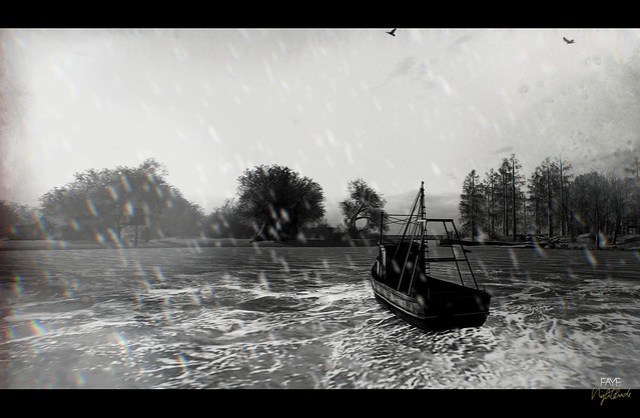
Faye Nightshade’s “Travel Journal | Winterstorm” is a fabulous picture full of energy and deeply situated in the place she is shooting. There are leading lines with the trees following the river. The dynamic movement of the boat is shown by its wake in the turbulent river and the camera becomes part of the scene thanks to the water on the lens. It’s just fantastic.
Mitch Wagner has a good article on Fierce Electronics that helps separate metaverse hype from metaverse reality, and naturally I have much to say on that topic:
So the metaverse is dead, right? Wrong. The hype bubble has collapsed. But the metaverse is growing.
“Metaverse platforms are growing slowly but steadily, and hiring commensurately,” says Wagner James Au… Metaverse platforms grew by 15 million users year-over-year in the first quarter of 2023, to 520 million monthly active users (MAUs), according to a report from the analyst firm Metaversed. That includes 149 platforms either live or in development, mostly browser- based but with some using virtual reality VR goggles.
And that’s just the prominent platforms with strong usage in the US and Europe, Au notes. It doesn’t include mobile-based Garena Free Fire, mostly played in Southeast Asia and South America, and enjoyed by about 10% of the population of the whole planet—700 million quarterly active users.
520 million MAU is a conservative estimate, by the way, even without including Free Fire and other non-localized platforms. For my upcoming book, I count well over 550 million MAU.
Ironically enough, what we're seeing now is a mirror image of what occurred in 2008-2010, after a couple years of media hype promoting Second Life as the next big Internet platform:



 //embedr.flickr.com/assets/client-code.js