
Here’s a Theory That’s Just Natural
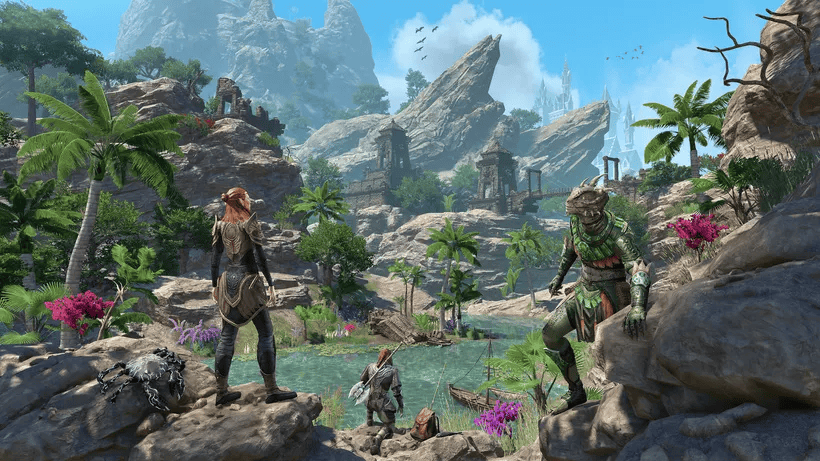
Above: Elder Scrolls Online, popular MMO in a fantastic-but-recognizably-earth-like setting
Originally published on my Patreon — join to read more articles like this first!
I recently asked some veteran game developers why we there are no massively popular science fiction-themed MMOs, and hinted I had a theory of my own. Scott Jennings and Damion Schubert definitely pinpointed part of the problem:
- Sci-fi is a less aspirational setting, than fantasy: “[T]he more ‘realistic’ the space MMO, the more it diverges from the heroic fantasy of ‘user is rescuing the world’ that most theme park MMOs guide you through.” (Jennings)
- Sci-fi tropes are less known than fantasy ones: “[T]he most emotionally resonant stuff in fantasy — dungeons, dragons, wizards, elves, dwarves, orcs and trolls — are effectively ‘open source’ and often lean upon shared and known concepts of history and mythology. (Schubert)
These reasons are definitely valid. Now let me add another one:
Humans generally prefer being in natural environments over long periods, versus artificial human-made ones.
I owe the kernel of this insight to my friend and colleague Amber Case (former technology fellow at Harvard, MIT, Institute for the Future), who first pointed me to research on the topic:
The [positive] mental effects of taking a walk in nature is not simply a matter of the fresh air, sounds of nature, and sunlight. As University of Oregon physicist Richard Taylor work recently demonstrated, we also prefer the sight of the natural world on a mathematical level. One of the major reasons for this is fractals.
Fractals are patterns that self-repeat at different scales, and they can be found all over nature in objects like trees, rivers, clouds and coastlines… And the response is a positive one. Humans experience less stress and better well-being when looking at nature, and this is driven by fractals.
“The human brain would rather look at nature than city streets,” Taylor and his team reported in 2022.
The deep human urge to look at nature seems to carry over into virtual recreations of nature.
Indeed, if you look at the top-selling videogames of all time, most of them are set completely or partly in a natural setting. Look at this chart, with all-natural settings in yellow, partly natural in orange:
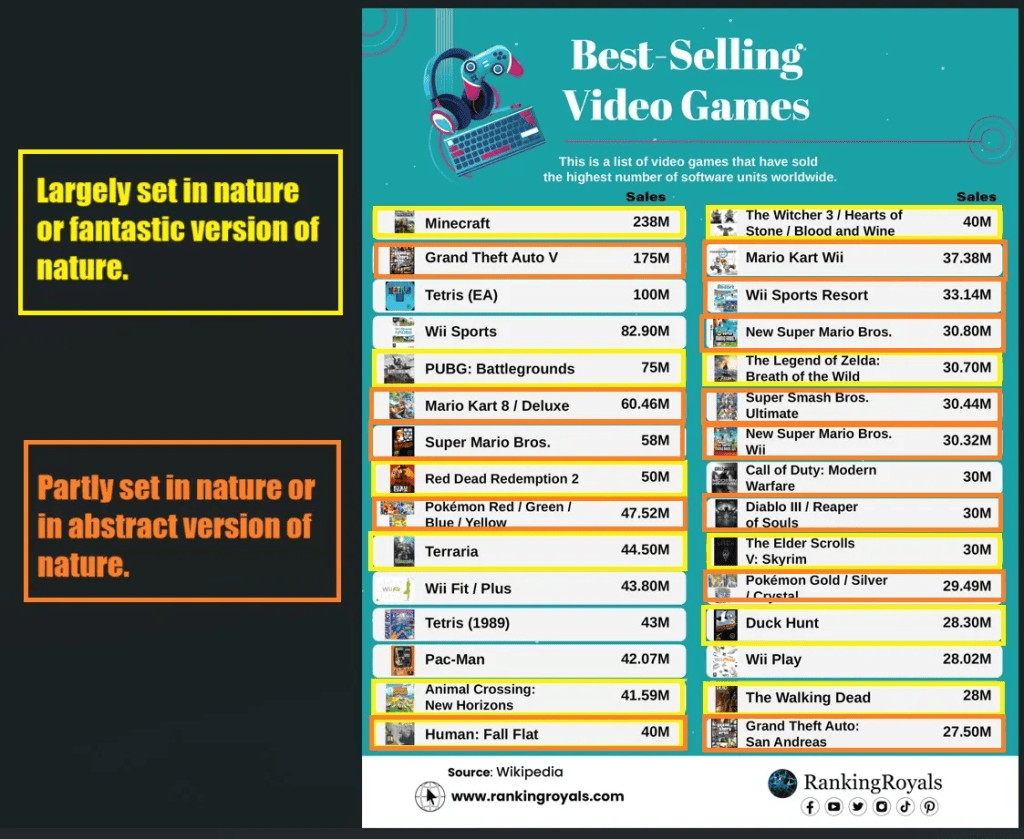
Not counting abstract/family games like Wii Play and Pac Man, pretty much all of these hits have a natural setting. Also notable that the only science fiction-themed game on this list is The Walking Dead, which also mostly takes place in a natural setting.
Amber herself noticed this collective desire for digital simulations of nature during the pandemic, and even prior, with the popularity of games like FarmVille.
“Lots and lots of games are about territory and outdoors and building,” she tells me. That sense was solidified for her personally when a friend gifted her the Japanese language version of Legend of Zelda.
“The feeling of exploring wilderness and caves was so amazing. Even though I couldn’t understand Japanese there was this very specific feeling that I felt with all future Zelda games,” she tells me. “This idea of a time lost in the past. Of something we used to do as humans and no longer did.”
She connects that to our shared human memory where we did spend much of our time in nature, and in danger, and striving to accomplish things there:
“That in medieval European times there was this memory of going through forests and fighting creatures and people and the unknown. And discovering. And leveling up. In a sense it stimulates that mental desire all humans have of nature and discovery. But without that being accessible anymore or a natural part of life, the virtual aspect provides it to us.”
This may help explain why Minecraft, with its simple but highly compelling simulation of a natural world was (and is) so popular and beloved:
“For people who didn’t live in neighborhoods where kids just came over [to play], you could get that same feeling, but it was infinite and even more composable. But we don’t really have that anymore [in real life], building our own home against the elements. So this strikes that feeling of being in nature and is thus successful.”
And here again, the human sense of fear of natural threats plays a crucial part in Minecraft’s popularity:
“To survive based on creepers for the first night psychologically binds the mind to the game. So you feel deeply connected because it’s visceral, like surviving on your own in the wilderness.”
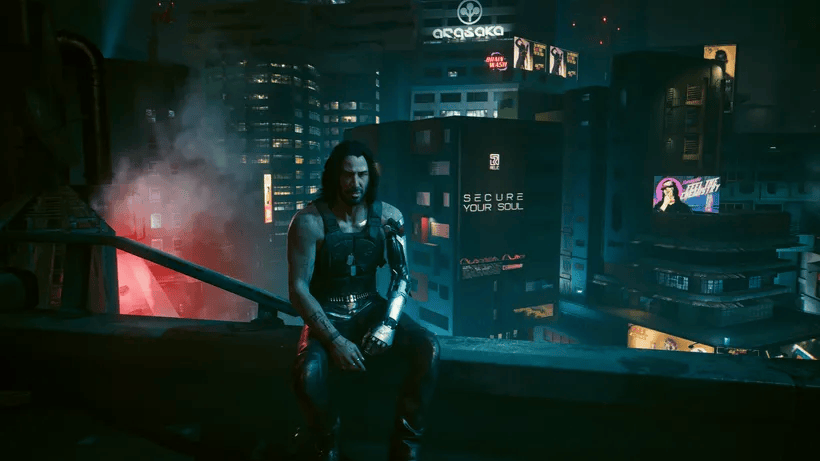
Above: My view of confabbing with Keanu in Night City
Skyrim vs. Cyberpunk 2077 vs. Second Life
Walking through this argument with Amber helps me better reflect on my own experiences in games and virtual worlds:
I recently began playing Cyberpunk 2077, a singularly badass roleplaying game set in a vast, neon-lined, dystopian city. I love the gameplay, the story, and the immersiveness of its sights and sounds. But I don’t love being in the world as an end in itself, as in somewhere I might fantasize about living in. I enjoy hitting the next plot twist and accomplishing quests for an hour or so at a time, but soon reach a saturation point. (Though Cyberpunk 2077 still accommodates many exciting missions that take place in the wilderness outside the city.)
It’s easy to contrast that with another favorite RPG of mine, Skyrim, mainly set in the earth-like forests, mountains, and meadows of Tamriel, where I’d often spend two-three hours wandering around for its own sake, not doing a quest at all — sometimes literally chasing butterflies.
I think these insights could be applied to Second Life, as it continues to struggle with bringing on new users. Part of the problem is it’s a virtual world that’s already been built over (over-built?) with human-made objects. Rather than entering a new realm that feels fresh and undiscovered, new users are mainly presented with whole cities and lived-in spaces. If the first few hours of Second Life felt more like entering a new realm with a sense of challenge, danger, and adventure, before introducing them to the entire bespoke world, I believe it would do much to grow the user base.
Advice for Science Fiction MMOs Developers
This theory, if correct, doesn’t mean science fiction games (or sci-fi MMOs in particular) are fated to be niche hits. To grow their market appeal, they should include more levels set in nature, or at the very least, include lots of trees, animals, and other natural artifacts. (The Star Trek franchise accomplished something like this, where instead of trapping the characters on a drab and cramped space ship, they could go on adventures in the wilderness – on the Holodeck.)
And this doesn’t necessarily mean adding alien planet versions of nature. Instead, you should fill it with flora and fauna that are basically recognizable: “Our brains didn’t evolve to calm down when we see [that]. A lot of people are playing games to chill out,” as Amber puts it. Instead, add “alien” foliage and animalia with unique colors and textures, but still have fractals that we recognize from nature, and follow earth-like development.
More than anything, Amber Case recommends that sci-fi games foster “the idea of awe and feelings of discovery [in players] — something larger than themselves.”
Originally published October 2025


Leave a Reply