


Wagner James Au / New World Notes

Author, strategist, virtual world reporter

Making of Second Life

Making a Metaverse That Matters

Contact me — links below!

ABOUT ME

My Patreon Supporters

Hypnotic Romance, an SL sim with secluded spaces for couples. Click here to teleport.

The Virtual Worlds Museum. Click here to teleport to their Second Life hub with tribute to sunsetted worlds!

“TV POWWW!” by Tom Boellstorff & Braxton Soderman. Read about the first televised videogame here.

The Fitting Room: Try out new SL fits in a secure, private space. Click here to teleport.

The Virtual Museum Team hosts several museums in Second Life, Wolf Territories Grid and Roblox. Check out all the teleport links here.

Breedables CoOp, helping the SL pet community grow through shared resources. Go here to get started.

  • Originally published on my Patreon — join to read more content like this first!

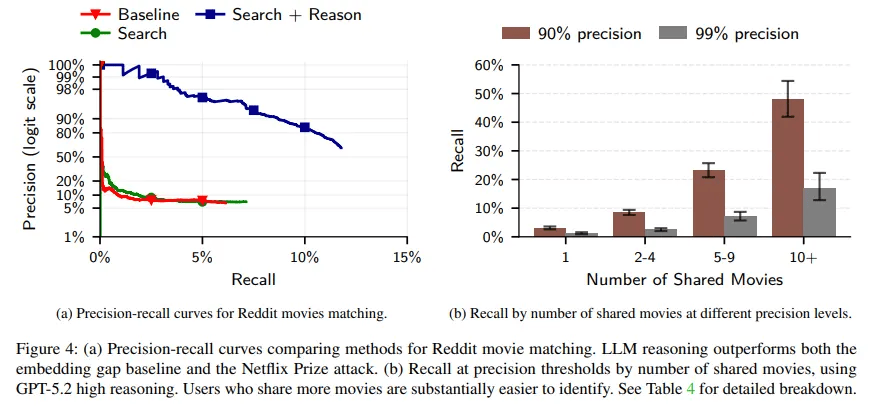
    Figure above: Real identities of Reddit users exposed by their discussions of favorite movies; from “Large-scale online deanonymization with LLMs” paper available at Cornell University’s arXiv

    Pseudonyms are crucial to virtual worlds, gamer hangouts on Reddit and Discord, and other online communities; they enable us to be more expressive and experimental with our activities online, without fear of personal judgement, or having our real life identities exposed.

    Maybe not anymore.

    At least that’s according to a new study that should probably be labeled, Warning: Hazard Ahead.

    A team of AI academics working with a researcher at Anthropic, a leading LLM company, were recently able to prove that Large Language Models like Claude and ChatGPT can de-anonymize pseudonymous user accounts on Reddit and Hacker News:

    Given two databases of pseudonymous individuals, each containing unstructured text written by or about that individual, we implement a scalable attack pipeline that uses LLMs to:

    (1) extract identity-relevant features,

    (2) search for candidate matches via semantic embeddings, and

    (3) reason over top candidates to verify matches and reduce false positives.

    So for example, the researchers were able to use this approach to connect pseudonymous users on Hackers News with their real life profiles on LinkedIn (”at 99% precision”).

    In another test, they were able to connect different Reddit accounts with the same real life owner, simply through the two accounts’ disparate discussions of favorite movies.

    More concerning, the authors add, it would be difficult for AI companies to block people from using their LLM service for deanonymization purposes. For one thing, the techniques they used involve some common, non-malicious content summarization and search/ranking tasks.

    For another, they note, “Not revealing any data on online platforms is difficult, as the data we use is the very data that makes online communities worthwhile.” IE, what’s the point of using Reddit if you’re not there to talk about your favorite movies, games, etc?

    Many or most of us use pseudonyms for pretty casual reasons. But for some of us, it’s a literal matter of life and death.

    This concern first hit my radar when Linden Lab briefly considered making it possible to link one’s Second Life avatar with their Facebook account. 15 years ago, this seemed like a good idea. Until:

    A woman who read my blog quietly messaged me and torched that notion to the ground:

    “You don’t understand,” she explained. “I have a friend in Second Life who uses it as her social escape valve, because she’s hiding from her abusive husband. He’s trying to find her. She can’t share anything on Facebook, because he’ll use it to track her down. She once mentioned playing an MMO on Facebook. Her husband figured out her username and started stalking her in the game.”

    [From Making a Metaverse That Matters]

    This dedicated ex-husband discovered her username (I assume) by doing a lot of time-consuming detective work on Facebook, blogs, and other Internet sites.

    But LLMs make this stalking process as quick and easy as entering in a detailed prompt.

    Many players of Second Life, VRChat, and other virtual worlds also use their in-game avatar name on Reddit and Hacker News. Could the methods outlined in this paper be used to de-anonymize people who are using game avatar names on Discord and forums?

    While declining to discuss specific platforms in the interest of academic ethics, co-author Joshua Swanson tells me this:

    “In general, any online forum where people write enough text is potentially vulnerable, and platforms where posts are publicly searchable are more exposed.”

    He adds that online identities are already vulnerable to exposure via AI search:

    “The basic capabilities already exist in current models, and it’s not straightforward for LLM providers to prevent misuse,” as he puts it. “Raising awareness of this is a major reason we published the paper!”

    How can owners of online accounts better protect their real life identity in the LLM era?

    Here’s some advice from the paper’s lead author, Simon Lermen:

    Individuals may adopt a stronger security mindset regarding privacy. Each piece of specific information you share – your city, your job, a conference you attended, a niche hobby – narrows down who you could be. The combination is often a unique fingerprint. Ask yourself: could a team of smart investigators figure out who you are from your posts? If yes, LLM agents can likely do the same, and the cost of doing so is only going down.

    Emphasis mine. More here.

    Co-author Joshua Swanson offers additional guidance going forward:

    “Use new accounts to post truly sensitive questions or information. Be aware that it’s not any single post that identifies you, but the combination of small details across many posts. And consider never posting anything you truly don’t want shared with the world.”
    Read their whole report here.

  • Not a 3D Slack / Discord but something more social and chill, it has Very Positive ratings on Steam and many thousands of players in it every day…

    Originally published on my Patreon — subscribe to read more content like this first!

    On-Together: Virtual Coworking is a new virtual world and a fairly new-ish spin on virtual worlds as a concept, in the sense that your On-Together avatar is also meant (as the title itself suggests) to represent what you are doing at that moment in the real world.

    Created by indie dev studio GigaPuff, the team was inspired to build it by their own remote working experiences from home:

    “We were doing unintentional body-doubling with friends on a second screen, sometimes online and sometimes just in the same room, sharing that quiet presence while we worked,” as lead developer/artist “Fizz” tells me. “Around the same time, we noticed a similar feeling in games. I’d open a life-sim, decorate an office-like room, and leave it running while I worked or did chores. It started to feel like the game was quietly coworking with me.”

    It also reminded them of virtual chatrooms from the early 2000s. “We realized this was exactly the experience we wanted to capture: a calm, comforting sense of togetherness while still doing your own thing, socially less demanding and in the chillest possible way. That’s how the idea of On-Together started.”

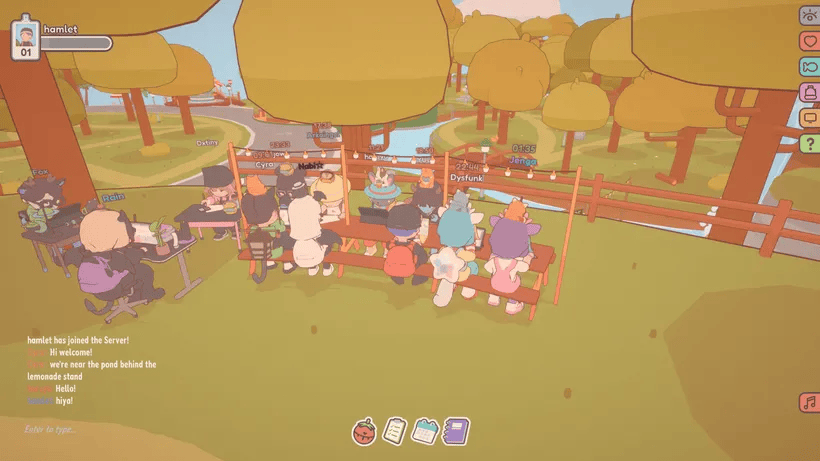
    It is supremely chill. And as you can see above, highly kawaii. I just visited one of the most active worlds, and someone called me over to join them at some picnic tables by the pond and lemonade stand. Which is where we all sat, most of our avatars tapping away at our keyboards, or quietly doing crafts. (You select your avatar’s work activity by hitting the Focus button.)

    “People tend to mirror what they’re actually doing in real life while they’re in a focus session,” Fizz tells me. “Because of that, computer-related focus types are some of the most popular. A lot of creatives in our community use art-related focuses, such as drawing on a digital tablet or painting on an easel.”

    There’s also options to select exercise or meditate as a Focus.

    “That kind of happened naturally and turned into a nice reminder to stretch a bit between sessions. Meditation focus activities are also quite popular, especially in more crowded groups, where they help build a shared sense of calm and solidarity.”

    True to a virtual world, Fizz and their teammates already see emergent behavior beyond co-working already happening:

    “Reading groups began forming, and D&D groups started spending time there. We’ve also had other game studios and indie teams reach out to us, saying they use it as a shared space while developing their games, especially remote teams that just want to feel like they’re in the same room.”

    There’s a handy option to minimize the screen, so your On-Together avatar and your companions remain on a corner of your computer display while you work on a Google Doc or whatever.

    “Some people have told us they use it to spend time with long-distance friends or partners. Seeing all of these different use cases emerge naturally has honestly been one of the most rewarding parts of working on the game.”

    My initial assumption was that On-Together might become a more immersive version of Slack and Discard for remote workers. That’s not GigaPuff’s intent, Fizz tells me.

    “It’s natural to compare it to other work tools, and of course teams or business owners are welcome to use it if they find value in it. But that was never the main goal. What we really wanted to create was an environment where employees, students, or anyone trying to learn something new or get things done can feel supported just by being around others who are doing their own thing at the same time.”

    So unsurprisingly, the team is evolving it to become even more of a virtual world:

    “On-Together is a living playground,” as Fizz puts it. “We want to keep it alive, evolving, and feeling fresh without losing its warmth. The community has been amazingly supportive and chill, and honestly, what makes the game special beyond the original idea is the people inside it. We hope the community continues to grow while still staying the chillest virtual co-working space out there.”

    With a Very Positive rating on Steam and many thousands of players in it every day since in its January 19 launch, it’s already serving a passionate community. I can see the game growing much larger as it’s discovered through word of mouth, to the point where it starts hitting Animal Crossing numbers. I also believe we’ll see other online games adopting similar co-working features, to encourage players to stay online, even when they have real life assignments to finish.

  • Originally published on my Patreon — subscribe to read more articles like this first!

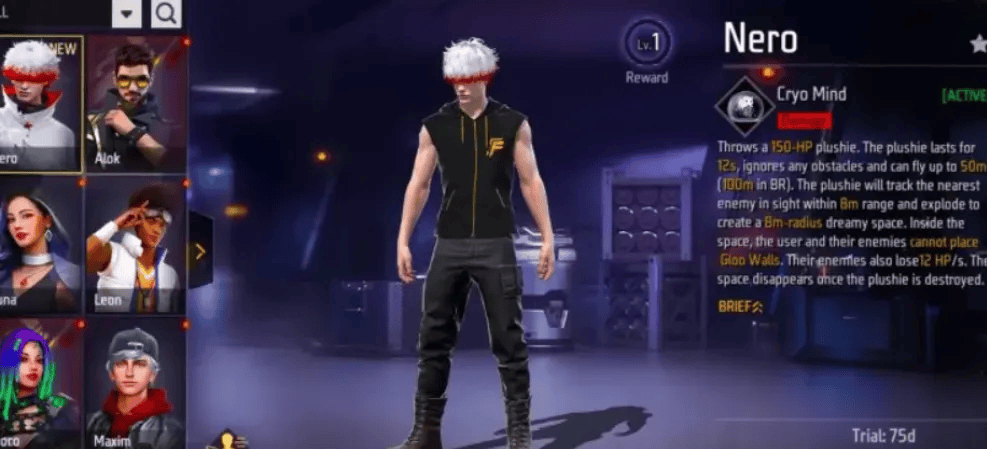
    Above: Some avatar customization options from Garena Free Fire, a ridiculously popular multiplayer game with metaverse platform potential

    Philip Rosedale recently lamented that he no longer believed, as he once did, “that our destiny as humans was to become avatars”. But setting aside “become” as a verb choice, it’s definitely true that quite a lot of us regularly use avatars to interact with other people.

    And that’s true even with a fairly narrow definition of avatar, one constrained to: a user-customizable 3D avatar in an immersive multiuser space.

    As of late 2025, there are about 6 billion Internet users in the world, according to Statisa.

    But how many of them regularly use a 3D avatar in a 3D online world?

    Here comes some citations, rough math, qualifiers, and a final estimate:

    As reported in the 2025 afterword of Making a Metaverse That Matters, I track about 700 million monthly active users on a metaverse platform (some half of them on ROBLOX, followed by Minecraft and Fortnite).

    But metaverse platforms are only one category of experience which offers user-customizable avatars in an immersive 3D multiuser space.

    Quite a few popular multiplayer combat games also boast those, including:

    • PlayerUnknown Battlegrounds: 125M MAU (Source)
    • Garena Free Fire: 120 million MAU (Source)
    • Valorant: 20 million MAU (Source)
    • Genshin Impact: 16 million MAU (Source)
    • Rust: 14 million MAU (Source)
    • Arc Raiders: 12 million MAU (Source)

    Then there’s classic MMOs, online RPGs, and virtual worlds, including:

    • GTA Online: 20 million MAU (Source)
    • Sky: Children of the Light: 20 million MAU (Source)
    • World of Warcraft: 7 million MAU (Source)

    That gets us to well over 1 billion people with avatars.

    So it’s safe to say that 1 in 6 people of everyone online in the world, regularly uses an avatar in that strictly defined sense.

    However, if we’re to expand the definition to include users of any 3D avatar in an immersive multiplayer space, we could include the titles where avatar customization is more limited. Including:

    • Honor of Kings: 260 million MAU (Source; it’s huge in China and much the rest of Asia)
    • League of Legends: 130 million MAU (Source)
    • Call of Duty Mobile: 30 million MAU (Source)
    • Overwatch: 25 million MAU (Source)

    If we count titles like those, we’re well over 1 in 5 Internet users who have a 3D avatar in an immersive multiplayer space.

    Then if we included 3D avatars in non-multiplayer games, such as Sims 4 with 85 million MAU (source), or immersive multiplayer non-human/humanoid avatars, including Rocket League, where players are soccer-playing vehicles (source) such as War Thunder, where players are tanks, with some 19 million MAU (source), we’d start approaching 1 in 4 Internet users.

    To play things safe, I usually keep my estimate at 1 in 5 with a potential to be “as much as” 1 in 4 of all Internet users.

    Also worth noting that 10 years ago, the number was closer to 1 in 14 Internet users**.

    Given that growth, how many billions of us in the world will have 3D avatars 10 years from now?

    I tend to suspect 1 in 2.

    How about you?

    *Sourcing most of these user numbers with credible references are savagely frustrating, so take them with some salt grains. Similarly, it’s certainly true that there’s some overlap (i.e. people who play more than one platform/online game), but I believe that flattens out over time.

    **Back in 2016, Minecraft had 40 million MAU, and Roblox, just 30 million MAU. Doing a full count from 10 years ago is far more difficult than estimating current numbers, but given that those two were far and way away the leaders, I’m assuming the grand total was under 250 million MAU when the entire global Internet had 3.4 billion users.

  • The antipathy is so savage and widespread, promoting a game as having any gen AI in it might actually hurt sales.

    Originally published early 2026 on my Patreon — join for more posts like this!

    In the final weeks of 2025, a leading game industry research firm quietly published a crucial report on Gen AI in games. Everyone interested in the topic should read it in 2026, because the key takeaways are quite noteworthy for the coming year — especially for the broader tech industry, where cultural interest and investment dollars are heavily focused on generative artificial intelligence.

    Because to summarize the consumer response data from in layman’s terms:

    Gamers hate, hate, hate gen AI in games with the ferocity of a thousand burning suns.

    That’s my own top takeaway from a survey of 1,799 gamers in Q4 2025, the latest report on gamer motivations from Quantic Foundry, a firm led by two Stanford and U.C. Berkeley PhDs which counts Tencent, Wizards of the Coast, and other top game companies as clients.

    But as co-founder Nick Yee puts it, in more formal language:

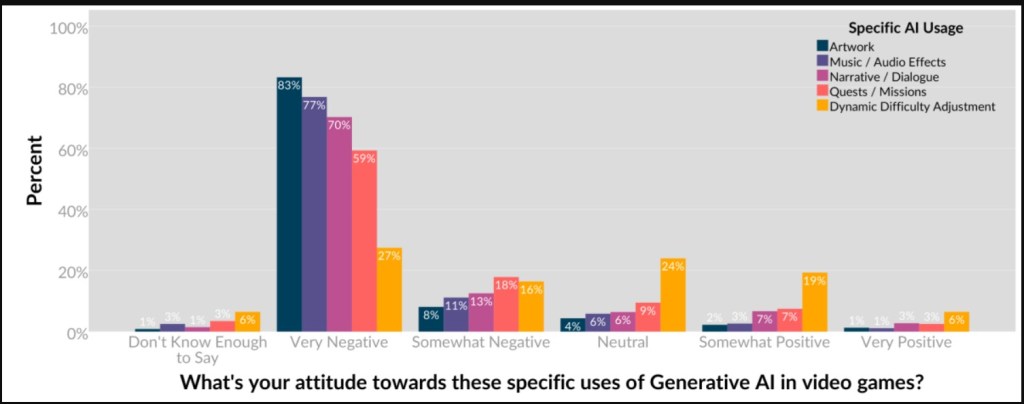
    Overall, the attitude towards the use of Gen AI in video games is very negative. 85% of respondents have a below-neutral attitude towards the use of Gen AI in video games, with a highly-skewed 63% who selected the most negative response option. Such a highly-skewed negative response is rare in the many years we’ve conducted survey research among gamers. [Emph. mine – WJA]

    The consumer negativity against gen AI is even greater than that against blockchain-based games, Nick notes, and we all know what happened to those.

    The antipathy is so savage and widespread, promoting a game as having any gen AI in it might actually hurt sales.

    “Given how polarizing and overwhelmingly negative most core gamers are towards gen AI,” as Nick puts it to me, “the main takeaway is exercising extreme caution with using gen AI for creative assets (artwork, narrative) as these risk alienating your most engaged audience.”

    This may be a surprise to many in Silicon Valley who’ve been touting gen AI as the next great leap in virtual world / game simulations. After all, figures like OpenAI CEO Sam Altman have promised that with gen AI, “movies are going to become video games and video games are going to become something unimaginably better.”

    But in an ironic twist, the people most passionate about the medium of interactive gaming, and who reliably spend the most money on it, overwhelmingly don’t want that hypothetical future.

    Why is Gen AI so alienating to gamers? I’ll get into that with Nick down the way. But first, I should point out some interesting nuances in Quantum Foundry’s data. For one thing, some gamers in some genres are somewhat less negative about gen AI:

    “Attitudes are very negative overall,” Nick tells me, “but the most comparatively receptive audience would be older, male gamers who enjoy games that emphasize power progression and de-emphasize customization and storytelling, such as Action RPGs like Path of Exile, shooters like Call of Duty, mobile RPG/Strategy games like Clash.”

    By contrast, he adds, non-binary people and women / girl gamers are significantly more anti-gen AI:

    “Part of the reason is that the identified motivational drivers are also how female/non-binary gamers are different from male gamers. So there’s an overlap with motivation and gender here. Female/Non-Binary gamers tend to care more about customization and storytelling, and independent of gender, gamers who care about customization and storytelling are more negative towards AI.”

    Also, there isn’t overwhelming negativity around all uses of AI in games, by the way — as the chart above suggests, there’s much less antipathy when it’s used to dynamically adjust gameplay difficulty.

    Nick again: “The best uses of gen AI in games (especially core AA/AAA titles) likely lie in figuring out novel ways of using gen AI for quality of life features like tailored tutorials, adaptive difficulty, tailored skill mastery and training sessions, etc.”

    This usage of AI is already well-known and long-established in games, which could explain why it provokes less animus. I personally recall dynamic difficulty adjustment advertised as a feature back in the early 2000s, with the first Max Payne game.

    What is also clear is that gamers are most negative about gen AI used in the artistic aspects of the medium — in the visuals, music, storytelling, and quest design. (Again, see chart above.)

    Which takes us to the why against gen AI. The backlash is more complicated, I believe, than many people in tech understand.

    The Culture, Costs & Morals Against Gen AI in Games

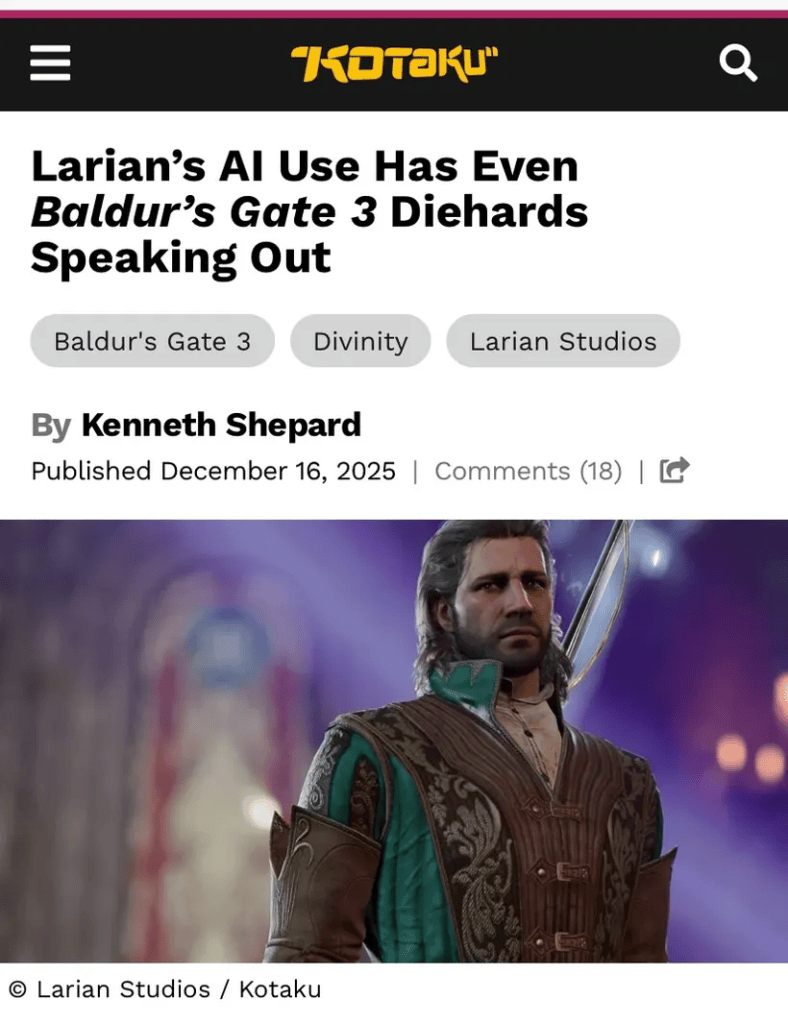
    Image credit and story via Kotaku

    Gen AI hype has been building at a time of rising retail costs for games, with major industry players openly saying a single title will soon cost upwards of $100. So any proposal to incorporate gen AI is apt to enrage cost-conscious gamers — especially since gamers are generally techy savvy early adopters. They’re likely to have played around with Midjourney and other gen AI platforms, and generally understand how the technology works — they know it’s not magic, but roughly know it algorithmically produces averaged output from pre-existing images and video that the program has been trained on. (IE, in this case, existing game content.)

    All this makes the cost-effectiveness of gen AI a deficit, not an advantage.

    As a gamer on Reddit might put it: “Why should I pay $85 for a game full of AI slop that I totally recognize from old games I’ve already played?!”

    “I think the tech-savviness and content quality combination drives a large part of it among gamers,” Nick concurs.

    But it goes even deeper than that. Most gamers consider their favorite titles to be works of art, with stories and characters that resonant deeply with them, and interactive challenges that they cherish overcoming. The idea of layering that experience over with automated, pre-digested material is deeply offensive to them.

    And therein lies the strength and ferocity of the backlash:

    “I think (anecdotally and based on my personal observations) that attitudes towards Gen AI have become very religious and tribal,” as Nick Yee puts it, “because the tech leads to large existential questions and the resulting discussion has taken on very moralistic and absolutist tones on both sides, and this feels unique compared to other tech hype cycles in memory–i.e., it feels like Gen AI has become framed as a ‘good vs. evil’ discussion. And I think among core gamers who see games as a creative work of art with soul, all these different layers are aligned.”

    And with the controversy taking on Manichean tones, I doubt we’ll ever see Gen AI incorporated into most games anytime soon — even when there are ways of doing so which aren’t “slop”. There’s simply no way of reaching Altman’s “unimaginably better” future of games when the current response is quantifiably worse.

    Infographic copyright Quantic Foundry

  • Here’s a Theory That’s Just Natural

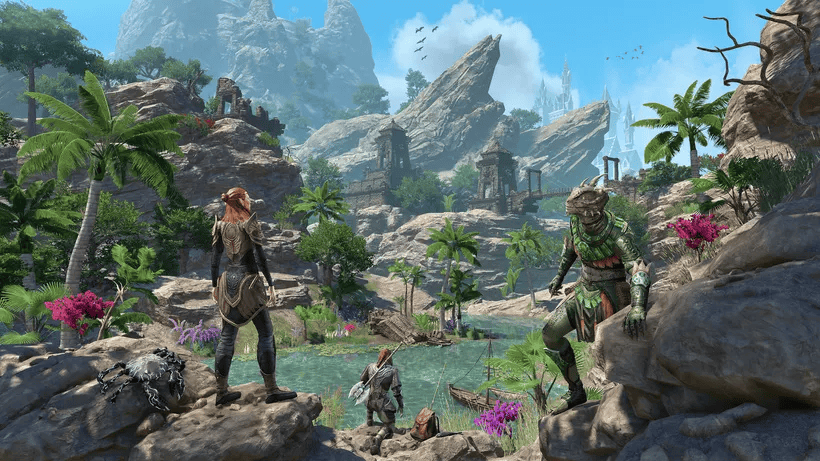
    Above: Elder Scrolls Online, popular MMO in a fantastic-but-recognizably-earth-like setting

    Originally published on my Patreon — join to read more articles like this first!

    I recently asked some veteran game developers why we there are no massively popular science fiction-themed MMOs, and hinted I had a theory of my own. Scott Jennings and Damion Schubert definitely pinpointed part of the problem:

    • Sci-fi is a less aspirational setting, than fantasy: “[T]he more ‘realistic’ the space MMO, the more it diverges from the heroic fantasy of ‘user is rescuing the world’ that most theme park MMOs guide you through.” (Jennings)
    • Sci-fi tropes are less known than fantasy ones: “[T]he most emotionally resonant stuff in fantasy — dungeons, dragons, wizards, elves, dwarves, orcs and trolls — are effectively ‘open source’ and often lean upon shared and known concepts of history and mythology. (Schubert)

    These reasons are definitely valid. Now let me add another one:

    Humans generally prefer being in natural environments over long periods, versus artificial human-made ones.

    I owe the kernel of this insight to my friend and colleague Amber Case (former technology fellow at Harvard, MIT, Institute for the Future), who first pointed me to research on the topic:

    The [positive] mental effects of taking a walk in nature is not simply a matter of the fresh air, sounds of nature, and sunlight. As University of Oregon physicist Richard Taylor work recently demonstrated, we also prefer the sight of the natural world on a mathematical level. One of the major reasons for this is fractals.

    Fractals are patterns that self-repeat at different scales, and they can be found all over nature in objects like trees, rivers, clouds and coastlines… And the response is a positive one. Humans experience less stress and better well-being when looking at nature, and this is driven by fractals.

    “The human brain would rather look at nature than city streets,” Taylor and his team reported in 2022.

    The deep human urge to look at nature seems to carry over into virtual recreations of nature.

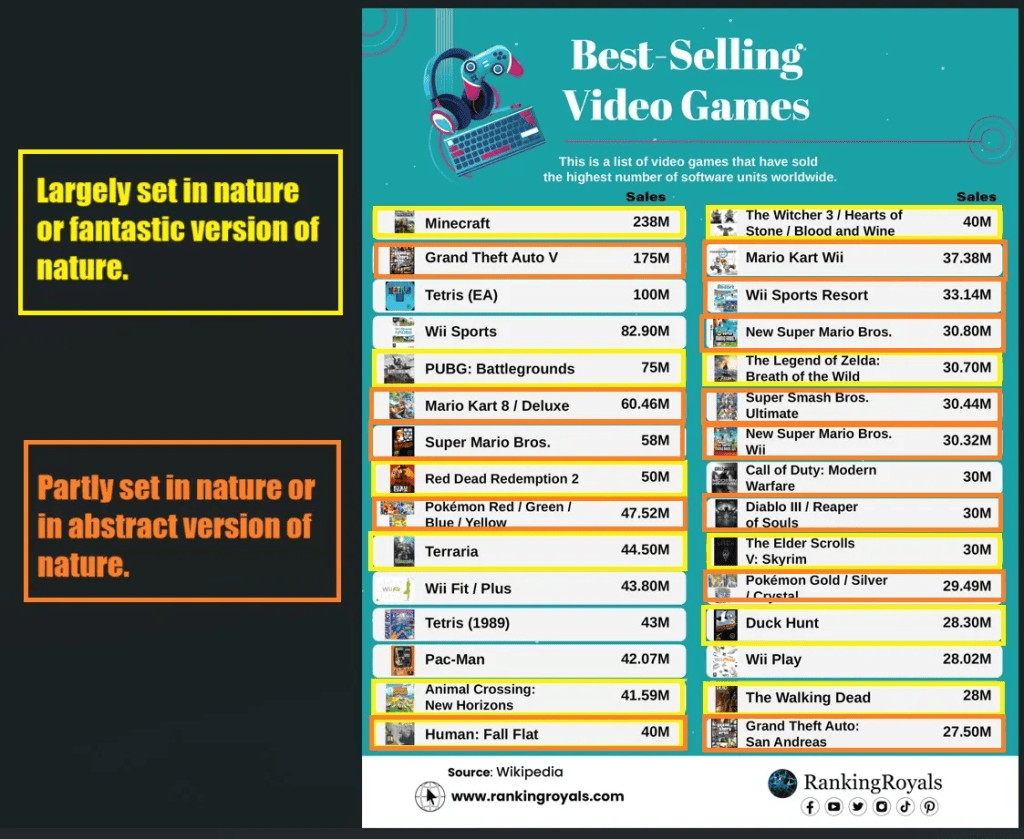
    Indeed, if you look at the top-selling videogames of all time, most of them are set completely or partly in a natural setting. Look at this chart, with all-natural settings in yellow, partly natural in orange:

    Not counting abstract/family games like Wii Play and Pac Man, pretty much all of these hits have a natural setting. Also notable that the only science fiction-themed game on this list is The Walking Dead, which also mostly takes place in a natural setting.

    Amber herself noticed this collective desire for digital simulations of nature during the pandemic, and even prior, with the popularity of games like FarmVille.

    “Lots and lots of games are about territory and outdoors and building,” she tells me. That sense was solidified for her personally when a friend gifted her the Japanese language version of Legend of Zelda.

    “The feeling of exploring wilderness and caves was so amazing. Even though I couldn’t understand Japanese there was this very specific feeling that I felt with all future Zelda games,” she tells me. “This idea of a time lost in the past. Of something we used to do as humans and no longer did.”

    She connects that to our shared human memory where we did spend much of our time in nature, and in danger, and striving to accomplish things there:

    “That in medieval European times there was this memory of going through forests and fighting creatures and people and the unknown. And discovering. And leveling up. In a sense it stimulates that mental desire all humans have of nature and discovery. But without that being accessible anymore or a natural part of life, the virtual aspect provides it to us.”

    This may help explain why Minecraft, with its simple but highly compelling simulation of a natural world was (and is) so popular and beloved:

    “For people who didn’t live in neighborhoods where kids just came over [to play], you could get that same feeling, but it was infinite and even more composable. But we don’t really have that anymore [in real life], building our own home against the elements. So this strikes that feeling of being in nature and is thus successful.”

    And here again, the human sense of fear of natural threats plays a crucial part in Minecraft’s popularity:

    “To survive based on creepers for the first night psychologically binds the mind to the game. So you feel deeply connected because it’s visceral, like surviving on your own in the wilderness.”

    Above: My view of confabbing with Keanu in Night City

    Skyrim vs. Cyberpunk 2077 vs. Second Life

    Walking through this argument with Amber helps me better reflect on my own experiences in games and virtual worlds:

    I recently began playing Cyberpunk 2077, a singularly badass roleplaying game set in a vast, neon-lined, dystopian city. I love the gameplay, the story, and the immersiveness of its sights and sounds. But I don’t love being in the world as an end in itself, as in somewhere I might fantasize about living in. I enjoy hitting the next plot twist and accomplishing quests for an hour or so at a time, but soon reach a saturation point. (Though Cyberpunk 2077 still accommodates many exciting missions that take place in the wilderness outside the city.)

    It’s easy to contrast that with another favorite RPG of mine, Skyrim, mainly set in the earth-like forests, mountains, and meadows of Tamriel, where I’d often spend two-three hours wandering around for its own sake, not doing a quest at all — sometimes literally chasing butterflies.

    I think these insights could be applied to Second Life, as it continues to struggle with bringing on new users. Part of the problem is it’s a virtual world that’s already been built over (over-built?) with human-made objects. Rather than entering a new realm that feels fresh and undiscovered, new users are mainly presented with whole cities and lived-in spaces. If the first few hours of Second Life felt more like entering a new realm with a sense of challenge, danger, and adventure, before introducing them to the entire bespoke world, I believe it would do much to grow the user base.

    Advice for Science Fiction MMOs Developers

    This theory, if correct, doesn’t mean science fiction games (or sci-fi MMOs in particular) are fated to be niche hits. To grow their market appeal, they should include more levels set in nature, or at the very least, include lots of trees, animals, and other natural artifacts. (The Star Trek franchise accomplished something like this, where instead of trapping the characters on a drab and cramped space ship, they could go on adventures in the wilderness – on the Holodeck.)

    And this doesn’t necessarily mean adding alien planet versions of nature. Instead, you should fill it with flora and fauna that are basically recognizable: “Our brains didn’t evolve to calm down when we see [that]. A lot of people are playing games to chill out,” as Amber puts it. Instead, add “alien” foliage and animalia with unique colors and textures, but still have fractals that we recognize from nature, and follow earth-like development.

    More than anything, Amber Case recommends that sci-fi games foster “the idea of awe and feelings of discovery [in players] — something larger than themselves.”

    Originally published October 2025

  • Originally published October 2025. Rec Room subsequently closed in June 2026 — read my post-mortem here.

    I’m still thinking about the painfully sharp layoffs of Rec Room staff of August 2025, because I’m not sure people in the metaverse platform/virtual world industry are seriously considering the implications. If you’ve been to an XR / game development conference lately, you’ve noticed they’re awash with panel topics in the vein of, “How Gen AI prompts will revolutionize virtual worlds!”

    But it just did the very opposite with Rec Room.

    A leading metaverse/virtual world platform, which I’m tracking as having roughly 40 million monthly active users, Rec Room has impressive user activity and numbers, but the company is not yet profitable.

    And Gen AI only put profitability farther away.

    Indeed, Rec Room’s official cutback announcement partly attributed the company’s troubles to the recent introduction of Maker AI, a prompt-based creation tool which “frustrated our more impactful creators.”

    How so? I reached out to a Rec Room staff member for more clarity on that point:

    “The AI frustration for top creators is for the obvious reasons you’d imagine,” they told me. “If you spent years building up skills to make top Rec Room games, you don’t want to see easier tools coming out that help others skip some of the learning steps and start building games and rooms faster than you were able to when you were learning.”

    What’s worse, a leading Rec Room influencer tells me Maker AI didn’t really help most veteran Rec Room creators — while at the same time, the existing tools they were working with to build and maintain popular Rec Room-based games and experiences had outstanding bugs and updates that needed addressing. (Causing still more frustration!)

    Did all that prompt-based creation with Maker AI encourage newer users? Maybe. But it also generated quite a lot of low quality slop that was expensive for Rec Room the company to support. (Gen AI requires quite a lot of compute power and data!)

    Rec Room management basically acknowledged this in an April 2025 blog post on Maker AI:

    Here’s what the average player is doing right now:

    Spending over 35 minutes with Maker AI

    Issuing over 300 prompts

    Generating more than 20 textures or canvases

    With great usage comes… great costs. The level of engagement is helping us get a handle on the resource demands of supporting AI-driven tools for creators…

    Right now, it looks like the money we’d spend to support a month of Maker AI for an individual is way higher than the RR+ [paid subscription] net revenue we get from that subscription.

    Emphasis mine, because in other words, the more time a Rec Room user spent using Maker AI, the more money Rec Room the company lost. It got so bad, the company also then announced that Maker AI would not be supported outside a user’s Dorm (personal space): “Doing so,” they explained, “would leave us financially upside down on each player using Maker AI.”

    The company then promised to spend the coming months to optimize and “bring down the costs of popular AI requests” — which again, meant spending more money and attention on an AI tool that could be going elsewhere. For example, increased support for the Rec Room creator community.

    And so AI was causing Rec Room to lose money, even while the overall platform had a large user base and decent revenue. (”Our balance sheet is actually pretty strong,” as an August 28 Rec Room blog post explains, “but we were spending too much money. That’s why we had to do the layoff. “)

    I’m reaching out to Rec Room’s lead developers, because I’d like even more clarity on what went wrong here. But in general, here’s a couple takeaways for all virtual world developers to consider:

    Make noob creation tools easier and more social.

    Prim/building block-based creation is already easy for new users to learn, and pleasurable in itself — clicking and dragging blocks into existence, connecting them with each other, setting them in the environment where other players can interact with them, is an experience already familiar in dozens of popular games/platforms. This rudimentary 3D creation could be made even easier (especially on mobile), but it remains core to the magic and appeal of virtual worlds. Not only is there no good reason to replace all this with prompt-based Gen AI — doing so tends to defeat the virtual world’s very purpose.

    In virtual worlds, UGC is more than just 3D building

    Not everyone enjoys playing with building blocks. But in a social virtual world built on user-generated content, all user activity is itself UGC. Emotes, chat, gestures — all forms of UGC which can and should be improved upon.

    Text chat alone is in sore need of transformation, since it doesn’t just have to be words on a screen. (Veteran Second Life users will fondly remember Starax’s Wand, which would cause surprising objects — pianos, cows, and the like — to literally drop from the sky during user conversations.)

    Or to put it another way:

    If you really want to revolutionize virtual worlds, think of new and delightful ways to amplify human creativity. Not to automate it away.

    Originally published on my Patreon.

  • Originally published September 2026 — see 2026 update at end of this post

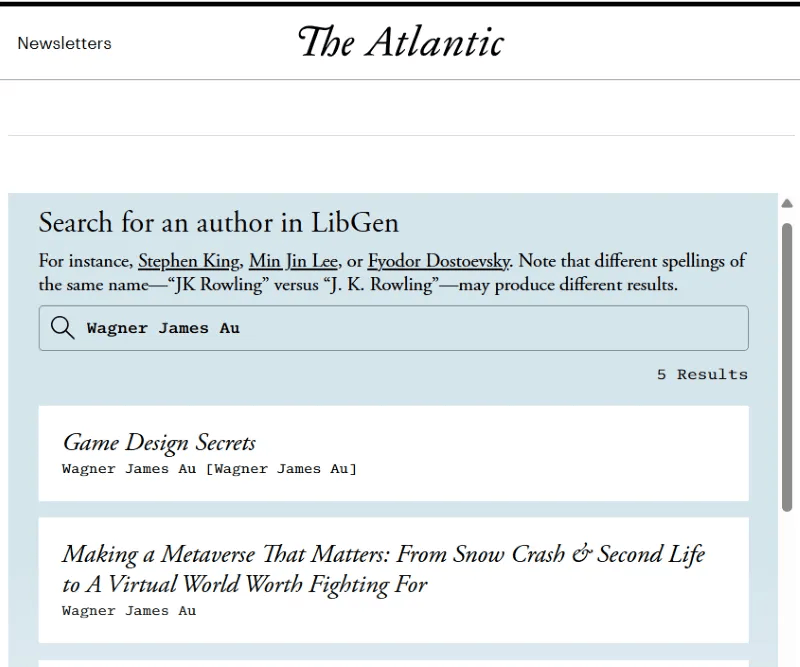
    Meta pirated millions of books to train its AI, the Atlantic reported earlier this Spring, including mine (as above). There’s even a helpful look-up tool here to find if your favorite author is in Meta’s training set, which is where I got the screenshot above.

    I’m not sure how I’ll protest, but it does bring up a related topic I’ve been thinking about lately:

    Does it even make sense to feed my latest book into an LLM?

    I’ve had friends / colleagues ask me something like that in recent years: “How about we upload your book into an LLM, so everyone can easily ask anything about it?”

    For instance, as the head of an AI company put it to me, explaining how this can be done:

    “I worked on a project where we hook near a petabyte of data to a LLM that just looped through doing research on authors of Gutenberg books. Then we turned the books into interactive books read by the authors own voice/style.”

    My immediate answer to the idea is on the order of: “Hmm, no that’s OK.”

    My more thoughtful, considerate answer is: “Fuck no I mean holy shit that’s not even how my book works. Jesus.”

    In case you’re curious — and the question keeps coming up, so I guess some people are — let me explain with more details and less cursing, specifically around Making a Metaverse That Matters:

    My book is a step-by-step argument and a set of stories enforcing that argument.

    To take the structure of my specific book, Making a Metaverse That Matters, it’s why the very first page defines the Metaverse, and is followed by a lengthy introduction which tells the powerful stories of five people I’ve profiled over the years, whose lives have been transformed due to the unique aspects of the technology, as I define it.

    I put the definition up front to immediately tell potential readers that my book is not about a vague, overhyped concept, but an actual platform category that already exists in early form. While each one of those stories illustrates a key facet of my definition.

    For instance, here’s the story I tell about Fran Serenade in the introduction:

    Fran noticed an odd thing: she seemed to be gaining significant recovery of physical movement — apparently, as a direct consequence of her activity in Second Life.

    “As I watched [my avatar],” she told me back in 2013, “I could actually feel the movements within my body as if I were actually doing tai chi in my physical life (which is not possible for me).”

    Using a virtual world, in other words, seemed to abate her Parkinson’s symptoms.

    … While the implications of this have yet to be studied to their furthest potential, they are likely to be profound — especially in the face of a rapidly aging population around the globe. From what we can tell, they are made possible because they happened in an immersive virtual world.

    The story illustrates why I say it’s essential that the Metaverse be immersive and a virtual world. And hopefully the reader is inspired by how it’s already helped people like Fran!

    All of that intentionality would likely be lost, if you just asked an LLM how my book defines the Metaverse. It would definitely be less inspiring.

    Which takes me to another point:

    My book is intended to be both inspiring and informative — but only best succeeds at both if it’s read from beginning to end.

    My personal favorite section of Making is the Epilogue, where I wrap up the stories of the people I write about throughout the book. I find these personal stories moving and inspiring, and hope the reader does too. But all of that is almost certainly missed, and definitely diluted, if someone was just to get them summarized by an LLM.

    Matters only fully matters, in other words, if you’ve read it from beginning to end.

    None of this is meant to suggest no book should be fed into an LLM/turned into a chatbot. That’s up to each author, for one thing; for another, not every book is intended to have a strong thesis or storyline, especially when it comes to technical / reference books. (My much more technical second book, Game Design Secrets, would probably work in an LLM, though it’s pretty out of date.)

    I also see quite a lot of potential in using LLMs to turn genre fiction books (especially fantasy and sci-fi) into explorable worlds — in that case, the book becomes like a kind of game design document. (In fact, I’m involved in a project along those lines, but more on that later.)

    So by all means, let’s experiment with books and LLMs integrated together — as long as each author gets to decide that for themselves. Trouble is, companies like Meta are actively trying to take that choice out of our hands.

    October 2026 update/disclosure: Shortly after writing this post, I joined a class action lawsuit of authors against Anthropic.

  • For years, a programmer kept having a recurring dream — more a nightmare, maybe — where they were lost in an endless library containing all the knowledge of the universe ever written, but where the seeker never finds the answers they are searching for. The dream was inspired, of course, by Jorge Luis Borges’ legendary short story “The Library of Babel”, which has been haunting readers, mathematicians, and artists since 1941:

    The universe (which others call the Library) is composed of an indefinite and perhaps infinite number of hexagonal galleries, with vast air shafts between, surrounded by very low railings. From any of the hexagons one can see, interminably, the upper and lower floors…

    Like all men of the Library, I have traveled in my youth; I have wandered in search of a book, perhaps the catalog of catalogs; now that my eyes can hardly decipher what I write, I am preparing to die just a few leagues from the hexagon in which I was born. Once I am dead, there will be no lack of pious hands to throw me over the railing; my grave will be the fathomless air; my body will sink endlessly and decay and dissolve in the wind generated by the fall, which is infinite.

    And for the programmer, who goes by the name “Mahu”, these words were the source of that dream they kept having for some 7 to 8 years.

    “I’d say that a big part of the way I experience the world is through my spatial perception of my surroundings,” they explain. “It tends to be one of the only things I remember about a dream if I remember anything at all.”

    But rather than just keep letting the concept remain a nightmare, Mahu did an unexpected thing:

    Mahu recreated Borges’ Library of Babel in VRChat.

    And it really is Borges’ vision realized in a virtual world. Not only are the individual rooms infinite, but the books on the shelfs are readable, and also infinite.

    “A goal of mine with the project to build a world where searching and finding the books felt meaningful,” Mahu tells me. “That means I wanted to build not only an infinite total library but I wanted it to be completely searchable and I wanted to make it possible to reasonably travel to the books you had searched for. The books near the entrance to the library where you load in have the fewest letters per page, and as you travel deeper they fill up with everything possible to put on a page of a book.”

    I just visited the Library of Babel in VRChat, and the ambition of this creation is staggering. For a comparison, I have to think back to “The Crooked House” of Second Life (inspired by a Robert Heinlein story), created in 2006 by mathematician Henry Segerman. In both cases, these are literary visions that can only tangibly, interactively exist in a virtual world.

    “The Library does things that are only possible in virtual reality,” explains Mahu. “It contradicts the laws of Euclidean coordinate systems, allowing you to seamlessly traverse what I call fractal space. So in a way my take on the library is perhaps more infinite than Borges’ had imagined.”

    And as Mahu made the Library of Babel in VRChat, something strange happened when they went to bed.

    “I can’t recall having many Borges’ library dreams per se in recent times since I have started working on the map. At least not the kind I woke up and remembered, that’s for sure.”

    Visit the Library here. More technical background on building the Library below.

    Much thanks to Adeon for the tip and shooting the video above! Engraving of the Library by Eric Desmazières via Design Daily.

    Please support posts like these by buying Making a Metaverse That Matters!

    CODING THE BOOKS

    “It doesn’t quite work the same way as most other Library of Babel algorithms that I’ve seen out there. It’s not actually randomly generated, my system places every possible sequence of characters on each page starting with like the letter A, then B, then eventually two letters, three, and so on. The text is not ordered neatly or anything though. The appearance is that it is totally random. That’s because I used a somewhat complex cipher to reorder everything.

    “It’s not a cryptographically secure cipher by any means, just far more advanced than something like a caesar cipher. It has some numeric weaknesses where you occasionally find books with repeating strings of text in them amongst the pages. Sometimes you find many permutations of things to the search phrase you were looking for within the same book. Which in my opinion actually adds to the experience making it similar to how the books in the short story are described.”

    CREATING THE LIBRARY

    “I named the system that runs the Library the ‘Langoliers’ system. The way that it works is a kind of graph traversal algorithm, where the Langoliers are responsible for recycling the world around you in real time. You can just keep going until the Unity game engine breaks basically.

    “(The Langoliers is the name of a Stephen King book. I haven’t read it but I have seen the movie — it wasn’t really very good honestly — but the Langoliers were weird entities that would eat the pockets of the universe stuck outside the normal flow of time or something.)”

    Originally published August 2025

  • Above: Me in a more innocent time (by which I mean 2024)

    It started with my good friend and staggeringly smart colleague, designer Amber Case (a former research fellow at MIT Media Lab and Harvard’s Berkman Klein Center for Internet & Society), raising problems with XR headsets in a recent essay, points that never occurred to me before.

    Briefly put, she argues that there are neurological and even evolutionary barriers to the effectiveness of an XR headset — because touch and even smell are essential to how we acquire knowledge:

    I asked my colleague Dr. David Sisson, a Ph.D. in Neurophysiology, why XR wasn’t taking off as quickly as the media promised. He pointed out that audio and visual information — the kind conveyed in HMDs — is only part of how we make sense of what we’re experiencing.

    Then there’s the quality of touch conveyed through force feedback in most XR rigs.

    “Without touch, there’s no ‘intimacy’. You’re not really interacting with what’s going on,” David told me. “You can hit a ball — and hear the ‘crack’ in VR — but you’re not feeling anything other than a little jerk in the controller that makes you feel like there’s some inertia happening.”

    Headsets and their up-close screens, in other words, deprive our minds of the tactile and situational context which feeds into how we build memories…

    The famous moment in French literature when the aroma of a cookie sends the author flying backward into his childhood memories has been validated by recent peer-reviewed studies — and strongly suggests digital memories formed apart from smells will be less vivid or indelible. Indeed, a recent study suggests that our sense of smell “may facilitate transfer of learning to other sensory domains”.

    Read the whole thing here. These are barriers that seem difficult if not impossible to overcome for mainstream adoption, but they’re rarely discussed alongside the usual culprits that supposedly hold XR headsets back: cost, weight, battery life, etc. Amber’s essay strongly suggests, even if the XR industry does get to the fabled point where the headset is the size and weight of sunglasses, most of us will still find the experience unsatisfactory, at least for most use cases.

    But surely there’s a solution to the neurological challenges she raised? I checked with two XR experts: Avi Bar-Zeev, who’s spent most of his career developing various VR/XR projects, including the Apple Vision Pro, and Jeremy Bailenson of Stanford, who’s led groundbreaking work in virtual reality for over two decades.

    What they told me was surprising:

    “Seems reasonable,” Avi told me, after giving Amber’s essay a read. “I don’t love HMDs either. But never say never. They’re the best option for now, but one day we’ll make a holodeck.”

    As for XR lacking tactile or olfactory interactivity: “Touch screens have some haptics at least. But the only way we get real touch and smell is for either matter printing like Star Trek [to be created] or BCI. Both are pretty dangerous.”

    By BCI, he means a Brain–Computer Interface — like the kind that reportedly (and horribly) killed monkeys during Neuralink trials. As for the holodeck and replicator of Star Trek, those are likely a lifetime or two away from being feasible, if ever.

    Bailenson also acknowledges the sensory barriers to XR raised in Amber’s essay.

    “Touch and Smell are critical for sensemaking in the world,” as he puts it to me. “The technological progress on haptics has slowed due to the dominance of cheap, consumer VR, but it is a question of when, not if, technology can reproduce the forces that one encounters in the real world. We are talking decades not years, but there is no true barrier other than time and money. ” (Emphasis mine!)

    In the short term, Bailenson points to some low budget experiments his Stanford team has performed, to simulate olfaction:

    “We have done some fun studies in the lab with ‘dime store’ scent implementations to surprisingly strong behavioral responses, such as dangling a cue tip dipped in vanilla off the headset to prime a donut scent.” (PDF report of that here)

    The far greater challenge is not the technology itself, he goes on, but the tech giants like Apple and Meta, who insist on promoting XR headsets for common, everyday consumer use.

    Bailenson believes that’s not where HMDs shine:

    “The biggest barrier to market adoption is not perfect realism, but use case matching,” as he puts it. “The technology companies are trying to foist a model of all day use upon VR, whereas my research indicates that it is not a medium for daily use, but best one reserved for special experiences (i.e., my DICE model). VR gets used plenty when it solves a hard problem.”

    By “DICE”, as he explains in this paper [PDF]:

    This approach recommends that we primarily use VR for dangerous, impossible, counterproductive or expensive experiences that are not easy to implement in the real world:

    Training firefighters, rehabilitating stroke victims, learning art history via sculpture museums and having a visceral, perceptual experience of the Earth’s future to understand climate change for example, all fit squarely in DICE.

    Alternatively, one does not necessarily need to don a headset to check email, watch television and conduct general office work. Such applications work better on 2D screens. By not putting such use cases needlessly into VR, society can avoid some of its challenges… [We] should focus on areas where VR is transformational and clearly the best medium for the job. [Emphasis mine]

    Again, Bailenson is the world’s foremost expert on virtual reality, yet the way he talks about it is utterly different from how Meta and Apple market VR. Or for that matter Avi, who helped develop Apple VisionPro, but seems to see current headsets only as an intermediary step, or even a necessary evil. (“I don’t love HMDs either.”)

    So if the experts say HMDs aren’t ideal for everyday use, but for very specific use cases (Dangerous, Impossible, Counterproductive, Expensive), why do Meta and Apple keep promoting their headsets as products destined to go mass market, for, say, watching movies or working remotely?

    That’s a subject for a whole other article, though it’s certainly in part due to echo chamber excitement among XR enthusiasts in those companies, and also partly from cynical, short term boosting of the company’s stock price. (Again, when writing my book, I could find no evidence that Meta even researched VR’s well-documented propensity to give females motion sickness, still another open topic.)

    For XR developers, however, this is all worth keeping in mind, and tempering their own expectations for the market they’re creating for, and the kind of applications most likely to succeed.

    If they asked me, I would not roll the dice beyond DICE.

    Originally published August 2025

  • This New World Notes blog is brought you by these 20th anniversary Patreon supporters:

    Please consider supporting their own virtual world projects. More details in the left column!