• InZOI celeb character 2

    inZOI's launch has been officially delayed until March 2025, but its burgeoning fan community is still avidly playing around with the character creator of the seriously quirky life sim game. (Like, seriously.) 

    One key test of avatar customization tools is this: Can you use them to create an avatar who clearly resembles someone whose appearance is already etched into your subconscious — i.e. a celebrity or character from popular culture?

    Here's several community attempts to do just that, starting with the one above. Answers at the very end of this post!

    (more…)

  • Power of Virtual worlds

    In cold and lonely nights, even digital bonfires can draw us together in

    I woke this morning in the wake of stunning US election results with a headache but after a predictable storm of emotions, these recent words of Philip Rosedale, on why he rejoined leading Second Life development, began flickering in my mind's eye:

    I'm super concerned about the state of the world. And I think that there is also a chance that our sort of dystopian future will drive more and more people into virtual worlds. 

    If it happens — or for the amount of time that we have to spend doing it — I'd like [virtual worlds] to be a positive experience, without evil advertising or surveillance or whatever. Without needing to read a Cory Doctorow book, we know that could get pretty bad with virtual worlds.

    He's right. We need virtual worlds designed to elevate the best versions of ourself — now more than ever. And no, not just as an entertaining "escape" from our offline troubles (though we will surely want them for that to). If you're reading this blog, chances are you know they are much more than that. For example:

    • Virtual worlds have a documented ability to give senior citizens and others deep social connections which would be difficult for them to create in the real world, especially if they have physical difficulty traveling outside their own. (There is even reason to believe they can help alleviate Parkinson's symptoms and other maladies.)
    • Specific to virtual worlds that are also metaverse platforms, their integration with the real world economy enable people to create new income streams for themselves — even create whole successful small businesses employing others.
    • And unique to all Internet services, virtual worlds and metaverse platforms have very large LGBT communities. In a user survey I conducted with top VRChat streamer Syrmor, nearly 1 in 5 VRChat users identified as trans/non-binary, or otherwise outside traditional cis male/female categories. I suspect this is the case with other virtual worlds; Second Life has hundreds of trans-related groups.  They offer safe havens for people who want to express their sexual/gender identity through their customizable avatar, often in ways that would be difficult or even dangerous to do in the real world. As I wrote last week, they are safe havens which are not safe during a new Trump Presidency — but all the more reason, per Philip, to create, advocate, and foster virtual worlds which better protect LGBT people's anonymity.

    Virtual worlds also offer us a respite from other popular ways interacting online, even to our detriment. They are powerful and important alternatives to social media, where content is algorithmically served to enforce our preferences (often at the expense of seeing a fuller picture of current events, if not outright misinforming us), and optimized to encourage anger with each other. (More anger equals more engagement.) These algorithms were certainly a key contributor to the 2024 election.

    In virtual worlds, no such algorithms of that kind exist. We must engage with each other serendipitously and in real time, always knowing that the avatar in front of us is an actual person in another part of the world. We know that so keenly, our avatars even follow the unwritten rules of eye contact and personal space.

    Philip, by the way, has related thoughts on his own blog, pointing to the larger economic forces which helped impel these election results:

    (more…)

  • Philip Rosedale returns Second Life

    Originally published on my Patreon

    Since last week's interviews with Linden Lab head Bradford Oberwager and newly-appointed CTO Philip Rosedale were so voluminous — between them both, the raw chat transcript was easily over 10,000 words! — here's the core revelations boiled down to ten key takeaways:

    Philip is not aiming to create a Second Life with an extremely mass market of users:

    Philip Rosedale:  I'm perfectly happy making it a really positive experience for a much smaller number of people. Like, that's totally fine… I'm struck by the opportunity. If we're a happy place for people like moms and vets, are there really only as many of those worldwide as we have using Second Life today? I'll leave it to you to do the same math as I have.”

    Over the years, roughly 50 to 60 million people have tried to install Second Life, but gave up for various reasons, usually due to addressable technical or design hurdles. A virtual world with 50 million monthly active users would be on par with the population of South Korea.

    Likely applications of AI in Second Life are a “matchmaker” to SL people and content, and an avatar appearance assistant:

    PR: So when you think about AI and Second Life, I want that AI to be a matchmaker between real people. One of the fantasies I’ve had is, imagine you have an AI that’s like a bot that says, “Come with me, James, and then it takes you, and it introduces you to somebody you might like. “I’m going to take you to this island where this guy built a lot of stuff I want to show you.” 

    That feels to me like a good use of AI. Having the AI be a sex bot, but you fall in love with it forever, does not feel like a good idea to me. 

    [An] AI might be able, for example, to help you put clothes on or change your clothes. Imagine the AI getting a permission and saying, “Hey, Hamlet can you click on this dialog box?”, and then, “I'm going to put another shirt on you.” 

    Improved Spatial Audio and Speech-to-Text is coming to SL:

    PR: [I]imagine Second Life, imagine text and audio, everything is converted to the other. So if you type text, it says Audio [as a UI option].  If you want to hear it, you just hear it. If you say something, it captions it and puts it into text. And so imagine Second Life being so accessible, because you can just use text or voice, you can turn the audio off, you can see the captions, we can start translating stuff to people in different languages. There's all these opportunities that I think are examples of how that's a really nice thing. 

    WJA: [S]peaking of spatial audio, do you think we'd be able to improve live music with that? Like you can have more people? 

    PR: Yep, stereo transmission, more people, lower latency. So yeah, yell at the band, they can yell right back at you. Well, if you remember High Fidelity, the same architecture we're building here will allow stereo streams and the whole thing. So you can do spatial and then if somebody wants to broadcast stereo, you can kind of set up the speakers, or whatever you want to do. So we'll have all those same capabilities built into Second Life as we modernize that system.

    Seven more beyond the break!

    (more…)

  • Spring🌼

    Cajsa Lilliehook covers the best in virtual world screenshot art and digital painting

    Pantoufle The Poodle is a Second Life resident that I only discovered yesterday, peeping out of the French group pictures. How could I resist that gorgeous face, so sweet and delightful. And then the camera, establishing Pantoufle’s bona fides as a photographer. It’s an account jointly  managed by Emeline Laks & Panda Banana who take Pantoufle out for walks and for snaps. 

    For more doggie adventures, click here:

    (more…)

  • It may seem obvious that more detailed graphics mean a virtual world is "better", but why is visual quality seen as so important, over other features? (Audio, text, user experience, narrative, etc.) As it turns out, this assumption was actually first shaped by a savvy advertising campaign from the early 1980s, developed by an ad executive who now calls it "a small but incremental step toward virtual worlds".

    In this exclusive excerpt from Intellivision, the new book co-written by Tom Boellstorff (longtime SLer and author of the acclaimed Coming of Age in Second Life), we go inside the marketing of the Intellivision video game console, and find out why sophisticated literary celebrity George Plimpton was chosen to be its surprising spokesman.

    Read it all below — and find a special discount for the book at the very end!

    "Closer to the Real Thing" — Excerpt, Intellivision: How a Videogame System Battled Atari and Almost Bankrupted Barbie, by Tom Boellstorff and Braxton Soderman

    The Plimpton campaign changed videogame history. It transformed Intellivision into a reality in the marketplace but also transformed the marketing of videogame reality. The campaign foregrounded realistic gameplay and graphics as the means to articulate differences between Intellivision and Atari. Market research registered the campaign’s ongoing effectiveness, indicating that “Intellivision is perceived as being better than Atari in terms of realism of game play” and “Intellivision owners most like the realism of the games.” 

    As media scholar Mark Wolf explained, the “‘realism’ of the games was the simplest and quickest way that consumers could compare systems, and the complexity of graphic detail and gameplay became the main areas in which home games would compete for players.” Although seemingly simple, the impacts of Intellivision’s marketing campaign were more complex and long-lasting.

    (more…)

  • Promising new SL brandLast month, New World Notes readers selected Aardvark and The Discord Experts as favorite new-ish SL brands. For November, I'd like to profile one or two other brands!

    If you'd like to nominate one, please post details in Comments. Here's info/criteria to include:

    • SL brand must be 5 years old or younger
    • Include brand's Marketplace listing and/or mainstore SLurl
    • Include brand's social media feed (Flickr, X/Twitter, FB, etc.)
    • Include a short explanation about why the brand is unique/interesting/worthwhile

    Please post nominations by this week! And yes, self-promotion is fine.

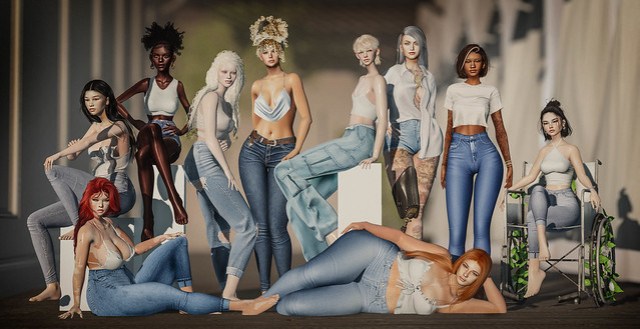
  • - Diversity I : ELLES -

    Cajsa Lilliehook covers the best in virtual world screenshot art and digital painting

    Loute Diesel and her many French photographer friends gather together every once in a while to do a group photo together and folks share their own shot on their Flickr page. I love to check in on these pics, because so often with the exact same setting and subject, their different pictures often reflect their own aesthetics. The similarity reveals the difference. 

    For another version from different eyes, click here:


    //embedr.flickr.com/assets/client-code.js

    (more…)

  • Almost harvest

    There's been much interesting reader response to my interview with Linden Lab head Brad Oberwager, but this one from "EmptyEyes" intrigued me most — pointing to core problems that are hurting Second Life user growth/retention, but are core features embedded within the platform: 

    Second Life's social stagnation is representative of fundamentally how the game works and the culture that it exists in. 

    Teleportation is the anathema of local communities forming near each other.

    IMs encourage private conversations which leads to a quiet world.

    Infinite space fractures groups, as people spread out away from each other to get their own small domains completely outside of others interference.

    The [online] Marketplace means that there's pretty much no reason to be present to shop in-world.

    These all end up having second and third order consequences that are also produce negative social outcomes. For instance, the activities in Second Life are building, character customization, talking, shopping, NSFW, sightseeing, and games. Because of the above reasons only shopping, character customization, and NSFW provide experiences better than or on par with other modern games. Pushing people towards these experiences and away from the others, making them feel empty. That emptiness reinforces itself forward.

    Also to be clear, I'm not saying that I don't like these things, lord knows shopping and NSFW are single handedly holding what exists together. I'm just saying that they encourage isolation and anti-social tendencies. Which I don't know how a mobile client and a trust and safety team are going to fix.

    Notably, argues EmptyEyes, the isolation and anti-social can't just be solved only by focusing on the mobile app for user growth (Oberwager) — more is needed:

    (more…)

  • Avatar metaverse Kamala Walz 2024

    SL image by Alsatian Kidd, who also has thoughts on the election

    When I briefly noted that Philip Rosedale had endorsed Harris/Walz during a recent YouTube livestream (watch below), some reader comments were somewhat surprising:

    Like Thanksgiving or Christmas dinner with family, politics really should not be discussed, and it really has no place in SL

    Rule #1 about all video games. Keep. Politics. Out. Of. Games.

    But Second Life is not even a traditional game: It’s a metaverse platform, which by definition, is integrated with the real world economy — and is therefore subject to government regulations formulated by elected politicians. Second Life content creators regularly receive bills from the IRS, which even has a written policy about taxing Linden Dollars; SL content must adhere to US laws banning online gambling, and so on.  

    There are hundreds of very good reasons to vote for Kamala Harris and vote against Donald Trump. But even if you are only thinking about the future well-being of your favorite virtual world/metaverse platform, and the user communities in them — be it Second Life, Fortnite, VRChat, or many others –  here are a couple core reasons to cast your vote for Kamala:

    Retaining Lina Khan to Protect Metaverse Companies & Consumers

    Lina Khan, appointed by Biden/Harris as Chair of the Federal Trade Commission, has been a fierce defender of both metaverse platform users and players against powerful interests. 

    Last year, her FTC won a $245 million refund for Fortnite players targeted by “dark patterns to trick players into making unwanted purchases and let children rack up unauthorized charges”. 

    And then this year, her FTC filed an amicus brief in support of Epic’s bid to require Google to open up in-app payment options apart from Google Play. As Tim Sweeney has often said, both Apple and Google’s control of mobile payment systems and their 30% commission fees threaten the future of the Metaverse. Just this week, Linden Lab’s Brad Oberwager mentioned to me how this IAP 30% charge is a serious challenge for fully bringing Second Life to mobile.

    There’s a huge number of other outstanding challenges for metaverse platforms. If Harris/Walz win, Lina Khan will in all likelihood remain head of the FTC.* If Trump wins, Khan — already a target of GOP animus and powerful donors — will be gone. Leaving metaverse consumers and creators to fend for ourselves. And whoever Trump/Vance appoints when Khan is gone, I wouldn't expect a full SL mobile app during their reign.

    There’s an even more important metaverse-centric reason to support Harris/Walz:

    (more…)