Cajsa Lilliehook covers the best in virtual world screenshot art and digital painting
Prophet ● is one of those slice-of-life photographers I admire so much. They have the patience to put together a scene, the furnishings, the mess of life, the pose, the clothes, and the lighting, all to capture a moment, a fraction of a second in a life. But a fraction of a second that will live forever or as long as Flickr. “Sing, Sing, Sing” is brilliant. There is the second-hand furniture, the snacks, the dog, the messiness of it all. This feels like living.
His avatar festooned in both a Black Lives Matter T-shirt and Pride-themed pants, Linden Lab CEO Ebbe Altberg gave an in-world "state of SL" talk yesterday in celebration of the virtual world's 17th birthday. You can watch the whole thing below, but as far as I can tell, Ebbe doesn't really make any major announcements. However, he does drop a hint at the company's plans for developing mobile apps for SL (at around 1:06 in the video):
We're still trying to figure out when we can actually enable the 3D viewer aspect of it into mobile but that's much further out for now we're working on what I would say is a communication companion app and I hope to see a beta of that pretty soon.
This is the first time I'm aware of that Altberg has acknowledged to the SL community that the company is working on a 3D viewer for mobile, which raises an interesting point:
Watch this single-take scene featuring a girl going down into the depths of a sprawling cyberpunk city for some take-out, then tell me: What do you think the budget to create it was?
Cajsa Lilliehook covers the best in virtual world screenshot art and digital painting
“Splash” by Angelika Corral is one of these pictures that bring me to a complete stop. So much of my time browsing I will page down and down and down almost mindlessly. I might pause and like a picture or two, but it’s seldom that I come to a full stop and look at the picture in its full-screen glory before I am thinking about writing about it. Corral is usually a black and white portraitist with only an occasional splash of color, but none quite so literal. I love the concept and think she executed it beautifully.
More stunning photos with Corral’s unique perspective on color.
If the definition of a monthly active user has remained the same then the comparison to the peak in 2007 is valid. Actually there were likely more than 350,000 new registered users a month in 2007 when SL hit the peak of 1.1 million MAU so the number of returning users could be about the same or higher than in 2007 using your math and logic.
This sounds right. 2007 saw a lot more churn due to massively promoted events like a cross-over experience for the television show CSI, mostly from people who were unable to install the program or get past the orientation. However, the definition of a monthly active user has definitely changed since 2007 — back then, Linden Lab would mainly refer to "Total Residents", i.e. anyone who signed up for an account, whether or not they even installed the program and went in-world.
The definition that hasn't changed is the amount of concurrent users, and that is indisputably much larger now than it was in 2007:
Journey, the acclaimed game that began its life as a Playstation title in 2012, is now (finally!) available to play on the PC via Steam. An enthralling, emotionally poignant trek toward a high mountain, the player must guide a robed figure across wastelands and civilization's remains, sometimes assisted by another robed figure who may be another player. As it happens, producer Robin Hunicke tells me, Journey was originally conceived as a kind of massively multi-user virtual world.
"When [director Jenova Chen] originally came to show me the pitch for Journey," as she remembers now, "it had an MMO vibe. Several of his concept art pieces featured long lines of people in dark robes following a path — almost like a pilgrimage to a holy site or an exodus from a war-torn land."
A multi-user version was prototyped, but the designers found that cooperative gameplay between several players could ironically become less social or cooperative:
Click here to directly teleport to Stand for Justice, a month-long fundraiser with all sales of SL items going to Black Lives Matter and other justice organizations. New SL style and houseware offerings are available in the upstairs wing — including virtual copies of art by rising artist Pippin Long. (Better known within the SL community as the RL daughter of Whiskey Monday, a talented artist in her own right.) Pippin's contributions to the fundraiser — as presented by Whiskey above– are these portraits above of legendary Black activists Angela Davis, Audre Lorde, and Marsha P. Johnson.
Speaking of fundraising, Stand for Justice organizers just let me know the event has so far raised over L$2.6 million in donations — i.e., over $10,000 in USD, when converted on the open market. (Screengrab for proof below.)
Cajsa Lilliehook covers the best in virtual world screenshot art and digital painting
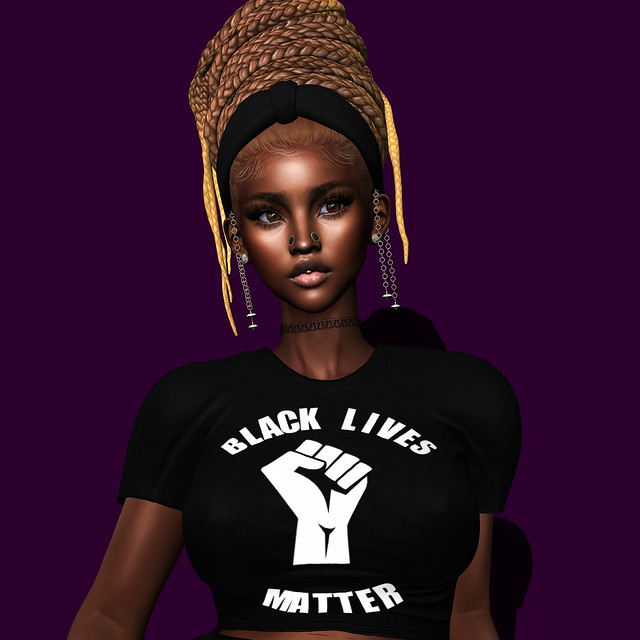
Sydd Sinister has been blogging for as long as I remember. Her archives go back to February 2009. She is widely respected for the thoroughness of her posts reviewing skins, but I was caught by this one, “Black Lives Matter.” This features a different place to find a Black Lives Matter shirt and Vanity Hair, a store doing hair for Black women for years.
This is not surprising, because founder and lead singer Roman Rappak was greatly inspired by a chance encounter he had with a taxi driver who told him about his second life.
If you listen carefully, in fact, you can even hear a snippet of audio from that conversation in “I Used To Say Things To Strangers” (above), one of the band's latest videos. In it, the driver is telling Roman about his alternate life in a Second Life community for Zen Buddhists.
“He kept talking about ‘this world’, as if his life in Second Life was much more important,” Roman tells me now, with wonder.
It helped him realize that “entire populations are more at home or feel more effective in the virtual world and have a greater level of agency there as opposed to the real world.”
Rappak got out of the cab, he recalls, “feeling amazed and scared.”
That was about three years ago, roughly around the time that the Brexit vote, which was greatly influenced by Cambridge Analytica’s manipulation of social media, had upended Britain, setting it on an unknowable course. “In a way Cambridge Analytica was a massively multiplayer RPG (Facebook) that made something fictional a reality,” Roman now observes.
With those two incidents, “I went through a complete epiphany, on how nothing a band can do can be a statement unless it adapts to the tools of the era.”
He means that in the same way how, in another era, artists like Jimi Hendrix used the latest technology in the 60s to create a sound that came to define that decade. It’s not enough to express how much of a change we’re going through, Roman believes, unless bands of this era adopt the technology of today.
“Things like Second Life say more just by existing than anything bands are doing,” as he puts it. "We should have gigs where after people leave, they feel like they had a view into a virtual world.”
Miro Shot has been doing just that over the last few years, performing shows where the audience wears VR headsets, putting them into an XR experience of the virtual and real. (The band even describes itself as “an AR/VR band/collective”.
A lot of these thoughts are reflected in this Miro Shot video and others. And while they also feature sardonic or darkly ironic images of technology use, it would be a mistake to assume their intent is anti-technology: