
- For Auction: Art Created By Artificial Intelligence From Artists Also Created By Artificial Intelligence
- Top Second Life Creator Is Importing His Avatars Into VRChat — And Successfully Selling Them For 10x The SL Price
- It Sure Looks Like Oculus Quest 2 Sold Between 1.5M – 2 Million Units In 2020
- How Mesh Devalued Prims In Second Life & Made It A "Consumer World"
- Google Open Sources Tilt Brush, Leaving Its Future To VR Community
- Virtual World Concerts Aren't Ideal For Acts With Great Real Life Stage Shows
- Monday Memory: One Of The Best Second Life Machinimas Ever Made
My Patreon Supporters
Hypnotic Romance, an SL sim with secluded spaces for couples. Click here to teleport.
The Virtual Worlds Museum. Click here to teleport to their Second Life hub with tribute to sunsetted worlds!
“TV POWWW!” by Tom Boellstorff & Braxton Soderman. Read about the first televised videogame here.
The Fitting Room: Try out new SL fits in a secure, private space. Click here to teleport.
Breedables CoOp, helping the SL pet community grow through shared resources. Go here to get started.
-
This striking abstract painting is by an up-and-coming artist named Taylor; you can bid on it for $200 or more soon, in hopes it becomes a rare collectors’ item that symbolizes the start of a new art movement.
Because the thing is, “Taylor” is not an artist and this is not a “painting” as we typically understand those terms. The painting was generated by artificial intelligence… as was the painter herself.
You can see more works by “Taylor” here, part of a fascinating project by rising technologist August Rosedale, whose development I’ve been casually following since the early 2000s.
Starting soon, Rosedale’s Mirage Gallery will auction off AI paintings like this to the highest bidder, and confirm their authenticity by registering them on a blockchain.
“I think that people will bid on AI-made paintings for the same reason people bid on human-made paintings,” August tells me. “People enjoy having beautiful art pieces around them and also can be invested in the idea of the artist's work increasing in value over time.”
The painting, to be sure, is not actually painted, and will come with a blockchain token.
“For the physical pieces, it will be a 24×24 inch canvas print. Each buyer can choose to sell the token and canvas print separately but the value will come from keeping them together.”
To create Taylor’s work, August compiled ten thousand or so abstract art paintings in a wide variety of styles, then fed them into a generative adversarial network, or GAN:
“The GAN works by having something called a discriminator whose job is to determine if an input image was from the original dataset or not. What this means is that the model that is training will create an image, and then feed it into the discriminator and see if it can convince the discriminator that the inputted image was from the original dataset. Over time, the model is able to create more convincing outputs that start to trick the discriminator.”
The only human input in their creation happened at the beginning, when August curated the datasets the AI then worked from:
“It is important for the datasets to have similarities in the images or else the outputs will be much more difficult to interpret,” as he explains. “Once the dataset has been made, the GAN plays a sort of game with itself to try to trick itself into believing that its own creations were from the original dataset. With powerful GPUs and lots of computing time, this process can result in amazing pieces of art. The Mirage Gallery artists will continue to refine their art with more hours of training as time goes on.”
Same goes for the personae and appearance of Taylor and “Alejandro”, the Mirage Gallery’s current representational artist:
-
Cajsa Lilliehook covers the best in virtual world screenshot art and digital painting
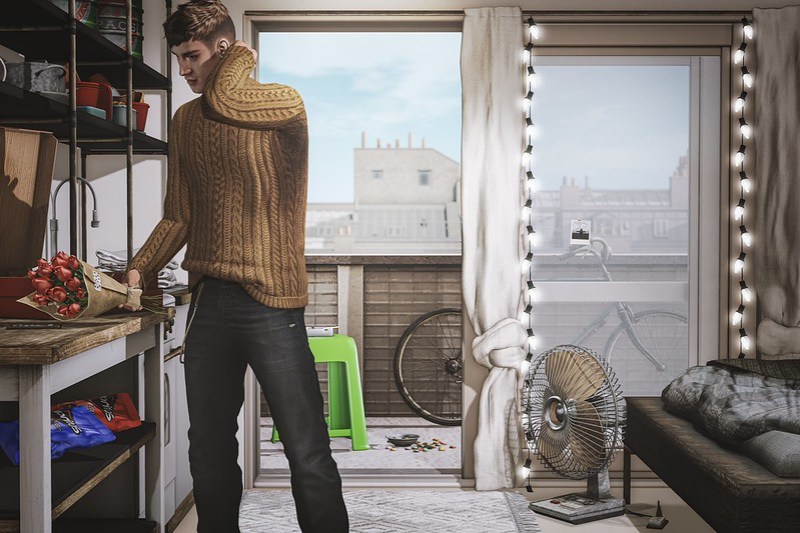
Tapas and Clothes is Trouble Dethly’s perfectly-named blog. Tapas are bite-sized servings. When I went to Spain, they were free with your beer or wine. You didn’t actually order the tapas, you got what you got, some olives, a deviled egg, a smoked snail, or smoked tripe, always a surprise. What Trouble delivers is a small bite of a story along with his blog photos. This is the first in a recent series. “Y él no tenía idea de que ésta era su última primer cita” suggests this will be a romance as he had no idea that this was his last first date. I love several things about this, the slightly tucked sweater, the realistic scene, especially that plastic stool out on the porch and the pile of bottle caps, the messiness of living alone.
Here’s the items featured above:
-
Ian Hamilton of UploadVR caught an interesting point in Facebook's latest earnings call/report:
Quest 2 “is on track to be the first mainstream virtual reality headset,” Zuckerberg said during the call… Facebook didn’t provide any specific figures for how many Quest headsets it sold. However, the company’s revenue in its non-advertising “other” category grew in the last three months of 2020 from $346 million in the same period of 2019 to $885 million in 2020. Oculus Quest 2 launched in October with a lighter, more powerful and less expensive follow up to the 2019 first edition of the headset.
"Other" almost entirely comprises sales of Oculus Quest headsets and software sales from the Oculus store. Given that Oculus Quest 2 hit the market in October 2020, we can make a fairly accurate estimate of how many units it sold in its first three months:
-
Cajsa Lilliehook covers the best in virtual world screenshot art and digital painting
Mei Vohn’s photostream is a glorious travel journal of Second Life sims highlighted by a person who sees the beauty in a single detail. Her pictures are very impressionistic. They make me think of the phrase “see through a glass darkly” from First Corinthians. Her pictures give us impressions, we have to go there to see it for ourselves. I just wish she gave Second Life teleport links to the places she's visited.
More sims through a glass darkly.
-
What you’re looking at above may be the first sign of a larger trend: This furry avatar for VRChat is now selling on Gumroad for $40. That’s not surprising, given VRChat’s fast-growing userbase.
What is perhaps surprising is that the very same avatar is selling in Second Life for a tenth of the price. That’s because “Krample”, who has been an SL creator for years (listed in the SL Marketplace as Orange Nova Avatars), is now finding far more success selling his avatar content to the VRChat market.
“I've been making content in Second Life for the past decade or so,” Krample told me last month, “but it's increasingly brutal to be working in an engine that's just so… old. Especially ever since I got a day job working in Unreal, because then I get to have a daily reminder about how much better things could be!”
He declines to discuss his specific day job for the record, but suffice it to say that if you've watched the Super Bowl recently, you've probably seen the visual effects he helped create.
“So I've just started to port my avatars over to VRChat, as it's a much more modern engine,” he continued. “It helps a lot that people in VRC seem to be willing to pay far more reasonable amounts for the same product, the VRC version of the same avatar costs about ten times as much. Which may sound obscene, but I am just following market rates.”
As evidence of that, he shows me a recent screengrab of other VRChat avatars on Gumroad (below) priced roughly the same.
OK, but how are his VRChat sales doing?
-
Cajsa Lilliehook covers the best in virtual world screenshot art and digital painting
“To Friendship” appeals to me with the easy nonchalance of the pose. Sitting back, relaxed, with a glass of wine, and a smoke, the way the light hits the bubbles in the glass and mixes with the smoke is just beautiful. And before you complain, there is no nicotine in SL cigarettes. Jimmey Hoffa’s photostream is a chronicle of his Second Life which seems to be an homage to the song, “Cigarettes and Whiskey and Wild, Wild Women.” For purists, the original by Ramblin’ Jack Elliott is here.
It’s not all glamour though…
-
Google's Tilt Brush, easily among the best VR applications made so far, is now available in open source… but it comes with a hell of a qualifier from Google:
As we continue to build helpful and immersive AR experiences, we want to continue supporting the artists using Tilt Brush by putting it in your hands. This means open sourcing Tilt Brush, allowing everyone to learn how we built the project, and encouraging them to take it in directions that are near and dear to them… Please note that it is not an actively developed product, and no pull requests will be accepted. You can use, distrAibute, and modify the Tilt Brush code in accordance with the Apache 2.0 License under which it is released.
I.E., Tilt Brush fans, you're on your own from here. The open source announcement has generated a lot of excitement among creators who use the software, but its viable future also faces some serious challenges.
"I really don't understand why the Tilt Brush artists are happy," as VR developer Blair Renaud put it on Twitter. "They assume that some magic programmers that don't like money are going to start working on Tilt Brush Xtreme edition or something? Highly unlikely."
"There would need to be a creative developer fund set up," AR/VR engineer Jasmine Roberts tells me. "Similar to the Tilt Brush Artist program but for both artists developers. Since they are not diametrically opposed."
Sean Whiting of Rec Room, which has seen impressive user growth in recent quarters, just put out an open call for Tilt Brush creators to bring their works into his virtual world, adding that Rec Room "[is] planning to pay out over $1M to our creators this year as creator payments spin up."

