Cajsa Lilliehook covers the best in virtual world screenshot art and digital painting
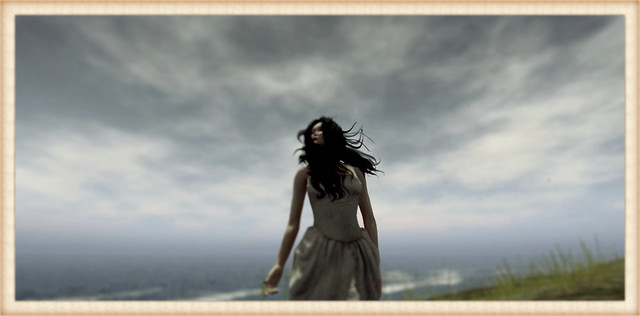
Keinenbika has some extraordinary pictures like this “Wish.” Veteran SL blogger Gogo pointed it out to me on Twitter. I was already following her but sometimes I have to just dive into someone's photostream to appreciate how great they are.
And Keinenbika is extraordinary. This is another “Is it SL or is it AI?” image thanks to how beautifully she captures the light.
You’ve probably seen this new Meta demo of podcaster Lex Fridman interviewing Mark Zuckerberg as ultra-realistic avatars while wearing VR headsets. While technically impressive, there’s a small problem: Decades of evidence that few people actually want ultra-realistic avatars mirrored after themselves in virtual worlds, that they undermine a unique value of the Metaverse — and worse, that they import high levels of toxicity into a virtual world's user community.
There is no proven relationship whatsoever between the popularity of a metaverse platform and photo-realistic graphics. The very most popular platforms, Minecraft and Roblox, are intentionally low-fi, immersive through their physics and responsiveness. Their blocky, whimsical avatars are similarly abstract.
The same can be said for the furry and anime-themed avatars of metaverse platforms VRChat, and the hand puppet-like avatars of Rec Room — both of which are so popular on Meta’s own Quest 2 headset, it caused the company to raise the price of the headset.
This preference for non-realistic avatars relates to the core user base for metaverse platforms: People in their teens and pre-teens, who are generally still uncomfortable and unsure about their own real life identity and appearance.
But the problem is even more acute for teen girls and young women, still negotiating the social expectations and judgements around their real life appearance; presenting them with a lifelike avatar to customize — let alone an avatar that resembles who they are in real life — is effectively asking them to shoulder even more social expectations and judgements, just in the virtual world.
The fundamental problem with Meta’s approach is that Zuckerberg, with no prior experience in game development or virtual worlds, apparently believes the Facebook model of real identities online should apply to the Metaverse.
This misses the essential value of metaverse platforms as a place where people can explore, imagine, and create entirely new experiences blessedly separate from real world limitations. Beginning with personal identity.
Overwhelmingly, metaverse platform users do not prefer avatars based on their real real-life appearance — even when the internal tools to customize them that way exist. This preference can even be seen in avatar gender choice. According to a survey of hundreds of thousands of gamers conducted by researcher Nick Yee and his firm, Quantic Foundry, 1 in 3 men prefer to play as a female avatar — with about 1 in 10 females choosing male avatars.
The irony is Mark Zuckerberg could have learned all this from the very person who helped bring the company into Metaverse development:
Cajsa Lilliehook covers the best in virtual world screenshot art and digital painting
お休みなさい or Good Night is the fashion blog on Tumblr of Filthy Imouto. Her style is fantastical, out of anime graphic novels or tv shows. Her pictures make me think she’s playing a find-the-avatar game. The picture above comes from Number 91 Ichigo.
Unlike most bloggers, she provides more complete credits on Flickr with more pictures (a close-up) on Tumblr. I love how she is falling into a bed of cherry blossoms and strawberries that so perfectly matches her outfit that you have to look closely, a clever way of getting you to stop paging down. Besides, doesn’t this make you think of a confection, like a strawberry trifle?
Finally bringing Second Life to the modern age of online communication, emojis are coming to the official Second Life viewer. You can even start playing with them now via this release candidate.
As befitting its status as a metaverse platform, this addition didn't come directly from Second Life publisher Linden Lab, but from a community developer: Kitty Barnett, who co-develops the third party SL viewer Catznip.
Kitty tells me her addition should support most every character from Twitter's open source Twemoji font.
"Aside from the multi-character emojis," she clarifies. "So yellow default smiley, not skintone-tinted emoji, or flags, or some of the job emojis will come in female and male variants, which is actually two characters joined behind the scenes — which wasn't easy to jury rig on top of the existing SL font system – or at least not on an initial go." It will also support shortcodes and non-English languages.
Even better news, Kitty was able to get Linden Lab to incorporate this addition simply by mentioning it and @-ig Second Life's official account on Twitter:
As we shared earlier, we are laying off around 16% of Epic employees… For a while now, we've been spending way more money than we earn, investing in the next evolution of Epic and growing Fortnite as a metaverse-inspired ecosystem for creators. I had long been optimistic that we could power through this transition without layoffs, but in retrospect I see that this was unrealistic.
While Fortnite is starting to grow again, the growth is driven primarily by creator content with significant revenue sharing, and this is a lower margin business than we had when Fortnite Battle Royale took off and began funding our expansion. Success with the creator ecosystem is a great achievement, but it means a major structural change to our economics.
To see the other, more hopeful side of the structural change, take a look at his infographic from analytics firm Game Discover, tracking the size of the Fortnite Creative economy. As you can see above, nearly 400 user creators are now able to earn an annualized income of $100,000 or more, while 61 creators are earning seven figures. On the very high end, five are earning eight figures.
None of this is meant to take away from the pain that Epic's now laid off full-time employees are feeling. (Fortunately Epic is giving them extremely generous exit packages.) Many of them, however, will now probably become Fortnite Creative creators themselves. So we should also note the impressive growth of this grassroots creator economy emerging:
Cajsa Lilliehook covers the best in virtual world screenshot art and digital painting
Claire Vuissent’s depiction of Wuthering Heights character Catherine Linton is so magnificent, I didn’t have to glance at the title to know she was running “out on the wily, windy moors.” (Yes, I know this is the original but I prefer the cover.) Claire embodies the spirit of Cathy searching on the moors for Heathcliff. To be honest, I love the song, admired the book, but have always disliked Cathy and Heathcliff. They are not good people.
For more fantastic images from Claire Vuissent, click here:
The Meta Quest 3 is here, with a starting price of $499, and before I begin ranting, let me start with the positive: It’s launching right out the gate compatible with Roblox (along with Quest 2 and Quest Pro), so it’s immediately metaverse friendly. That’s good!
Now to rant — or maybe “stand there, utterly confounded and amused ” is a better way of putting it.
The Quest 3 launch reflects a complete shift by Meta, openly imitating Apple’s Vision Pro launch from early this year. You can see that in the product trailer above, and it’s heavy, near-complete focus on Mixed Reality experiences.
Oculus Quest changed the game for wireless VR. It delivered fresh experiences for enthusiasts and new opportunities for developers, all while introducing immersive gaming to newcomers across the globe. Today, we’re excited to announce Oculus Quest 2, the next generation of all-in-one VR. Quest 2 pushes the state of VR forward with a redesigned all-in-one form factor, new Touch controllers and our highest-resolution display ever.
Immersive experiences like virtual reality can transport you to fantastical worlds that defy the laws of physics, but the physical world — and the connections you’ve made there — are pretty important, too. We believe you shouldn’t have to choose between them. That’s why Meta Quest 3 features breakthrough mixed reality that enables a spectrum of experiences.
This paragraph is actually the only time “virtual reality” is mentioned in the Quest 3 announcement.
Mentions of “mixed reality”: FIVE.
On the one hand, this reflects the reality that the Quest 2’s VR-forward approach has failed to gain mass market traction, with only 20 million or so units sold. Further, I wouldn’t be surprised if this is partly an attempt to shift away from the nausea effects from full VR experiences that I mention in the book.
Cajsa Lilliehook covers the best in virtual world screenshot art and digital painting
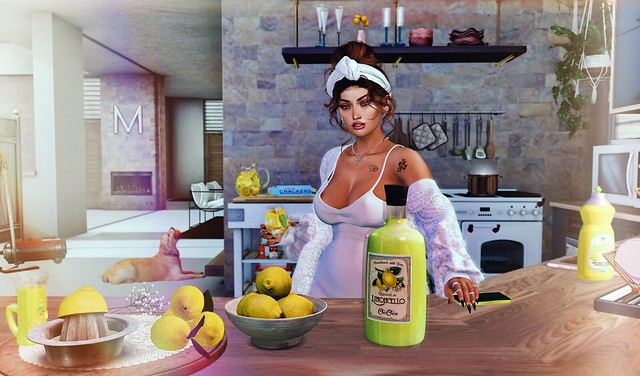
~♡~ Megs ~♡~ has a fun stream with an assortment of mise en scène pictures of her enjoying her Second Life. Here she is in “As far as I know, I’m delightful” in which she embodies the saying “If life gives you lemons, make limoncello.” She paired her picture with the delightful song “Lemons” by Brye.
And then those darn pesky humans at the Writers Guild of America organized, went on strike, and in a few months, got the world's largest film and TV companies to agree to these highly restrictive terms around AI:
We have established regulations for the use of artificial intelligence (“AI”) on Minimum Basic Agreement-covered projects in the following ways:
AI can’t write or rewrite literary material, and AI-generated material will not be considered source material under the MBA, meaning that AI-generated material can’t be used to undermine a writer’s credit or separated rights.
A writer can choose to use AI when performing writing services, if the company consents and provided that the writer follows applicable company policies, but the company can’t require the writer to use AI software (e.g., ChatGPT) when performing writing services.
The Company must disclose to the writer if any materials given to the writer have been generated by AI or incorporate AI-generated material.
The WGA reserves the right to assert that exploitation of writers’ material to train AI is prohibited by MBA or other law.
So I'll just call it right now: The WGA agreement signals the end of generative AI having any chance at becoming a disruptive force in the creation of intellectual property.



 Wagner James Au / New World Notes