
- Two Best Practices For Building Virtual Worlds — Excerpt, Making A Metaverse That Matters
- How Will AI Change Storytelling In Games? Leigh Alexander & Writers For Divinity: Original Sin 2 & Deus Ex Have Nuanced Takes
- What Questions Should I Ask SL Content Creators In My Upcoming Report Of The Virtual World's UGC Economy?
- Cajsa's Choices: SL Monochrom, A Flickr Group Devoted To Beautifully Photographing The Virtual World In Black & White.
- Sannyのおすすめバーチャルワールドニュース : 2024年4月 Sanny Reports For Virtual Japan
-
Many Second Life users on Flickr have recently been hit by platform warnings — as pictured and explained in this message from Flickr Staff — with some getting hit by outright bans.
Overall the main issue seems to be that Flickr the company is penalizing users who excessively tag other Flickr users in their images, thereby "polluting" the platform's search results.
But why the excessive tagging? Likely because these Flickr users are actually influencers, promoting various Second Life brands in the images they upload:
"The way views are calculated on Flickr, any time a group loads, you get a view if your photo is shown," as longtime Flickr creator and SL blogger Gogo explains. "It doesn't mean anyone actually clicked on your photo. So SLers are spamming SL groups, and sometimes non-SL ones too, to game those views."
Enforcement against that spamming activity seems to have stepped up recently, and been pretty harsh, especially for Flickr users without a paid account: "I can see why Flickr is cracking down," says Gogo, "but I don't like how they are going about just closing accounts without a warning, or the ability to remove all group/tags/ whatever, in their batch editor."
The underlying problem is likely this: These Flickr influencers are using their images to promote content for SL brands (usually in exchange for free merch), even though the free version of Flickr isn't really designed for posting promotional images at all.
For Flickr influences, there is a relatively easy solution to this:
-
Cajsa Lilliehook covers the best in virtual world screenshot art and digital painting
Piment Plutonian has a blog called Piment Plutonium naturally. Here recent post, Music gives a soul to the universe, wings to the mind, flight to the imagination and life to everything, has this great rockabilly vibe that I love. It’s not just the bold red and white stripe. It’s the attitude.
Top: Mutresse Velka Top (DSU), is available NOW at Collabor88 Event
Hair: Unorthodox Flow at Mainstore
For more from Piment, click here:
-
Excerpt, Making a Metaverse That Matters, Chapter 14: Metaverse Lessons for the Next 30 Years
Community Creates Value — Not the Other Way Around
The failure of Decentraland and other blockchain-based metaverse platforms, as we saw in Chapter 6, illustrates the limitation of virtual worlds that begin with virtual real estate sales and other speculation. The user base that is attracted to them tend to be there in search of easy riches, and rarely become active participants in the virtual world itself. (This principle may change of course with the advent of Neal Stephenson’s Lamina1, but as of this writing, that’s still unclear.)
By contrast, one rule of thumb for judging whether a metaverse platform is successful is this: You will find a subset of content creators who create not for profit, but for social recognition among the user community — even when it involves work directly related to their real profession.
We have seen that in strong examples of this across many metaverse platforms, from a professional game artist creating a free Portal tribute in ROBLOX to prove the platform's power, to an unemployed developer who created and then open sourced a C# compiler to help VRChat creators, to a technologist with IBM creating transcendent works of immersive art in Second Life simply for the sake of sharing that vision with others.
This social spirit is not simply about idealism. Second Life founding member Hunter Walk, who left Google/YouTube to become an influential venture capitalist, sees this community-centric approach as fundamental to its sustainability as a platform.
As he puts it in a rhetorical question: “Is this a space that feels owned by the people or does it feel owned by companies — where the business model was set before the creative model? My belief is that parts of a successful metaverse will be more open and jazz-like — creative model first, business models second."
A related realization is that getting community correct first and foremost matters most of all,
"If you invest in creating a positive environment up front,” as Linden Lab/Meta veteran Jim Purbrick puts it, “you can get a positive feedback loop. If you don't set that up front and up with a toxic environment, it's super difficult to turn that around later on."
NEXT: How default avatar options shape a metaverse platform's entire culture:
-
Cajsa Lilliehook covers the best in virtual world screenshot art and digital painting
Deborah Lombardo [Harbor Galaxy] is an astonishingly accomplished artist. Her stream is overflowing with one great painting after another. I say painting because her SL screenshots with a texture overlay or two look like they have been painted. It’s impossible to pick just one or three of her “best” pictures because everyone seems the best. I chose “Audacious Playground” because her dress in this image (above) made me think of another artist, Eshi Otawara, and her famous fishhook dress. Folks who joined SL after mesh have no idea the kinds of inventive and glorious clothing we used to wear.
For more from Deborah Lombardo, click here:
-
To go by social media froth, the rise of AI technology like Large Language Models is soon going to utterly Change Games Forever, leading to waves of roiling layoffs of game industry employees. Why pay game writers, one common argument goes, when we can just get ChatGPT to churn out reams of NPC game dialog?
Speaking with several actual writers of hit acclaimed games, however, I got a much more thoughtful perspective, bereft of doomsaying.
Leigh Alexander, an independent writer who contributed to the award-winning Reigns: Game of Thrones (2018) among many other titles, sees understanding tools like LLMs as crucial to her profession:
“Kinda feel like writers need a nuanced view of generative technology to keep up in the game industry right now,” as she puts it. “There's a big big big gulf between ‘working with generative systems to have an emergent relationship with my own writing’ and ‘having ChatGPT write the NPCs.
“The latter is an exploitive fad that I expect to soon collapse. The former isn't going anywhere and probably if you work in games you'll need to be more literate with it than [saying] ‘all AI is lazy’– which is itself a lazy view. You still gotta hand-author everything in your own models, and consider applications of emergence deliberately and for a reason, because it often makes things harder.”
She likens the “AI is lazy” charge to a photographer saying, “‘Photoshop is only for lazy photographers’.
"It misunderstands the purpose and breadth of the tool, and it actually makes you sound like you don't understand photography (which seems bad for your prospects if you are working as a photographer).”
Above: Reigns: Game of Thrones, co-written by Leigh Alexander
By contrast, Leigh adds, “professional longevity for storytellers in the game industry means not just writing, but literacy with tools — tools are the backbone of narrative design to me.”
Charlene Putney did narrative design for the recent hit fantasy RPGs Baldur’s Gate 3 and was a writer on Divinity: Original Sin 2. She also co-developed LAIKA, a LLM tool for game writers “to offer suggestions using their voice, characters and concepts.” So as you might guess, her view on AI is also nuanced:
"I think AI will bring big changes to every creative field over the next few years, but not in an apocalyptic way,” she tells me. That’s even more the case with the game industry, which unlike the other arts, is only a few decades old. By her lights, AI offers games a chance to differentiate itself from other medium even more:
Above: Baldur's Gate 3, featuring narrative design by Charlene Putney
“To my mind, this is another tool. I don’t see it replacing writers in the long run, I see it as a brand new spark of potential that we can use. And that beautiful little spark of potential in it that delights me is the same little spark that delighted me in the independent game development scene a decade ago: dream it up, make it, share it — now using the tenets of consensus reality as LEGO bricks. Not trying to recreate the media of the past: not novels, not movies, not songs. But some strange new creatures, new forms that are no more than shadows right now, coalescing into shape just out of the corners of our eyes.”
To that end, she’s creating other LLM-based tools for game developers, though notes that many of them are too busy — or perhaps too apprehensive — to experiment with them.
"With the strong productivity focus of the current games industry, it's hard for people to take time to play, to explore, and to bounce around with experimental things when there are hard deadlines and such a hostile general approach to working with AI,” as she puts it. “One needs a strong sense of self to weather the social media vitriol, and a strong sense of your own voice and what you want to say in order to experiment wildly."
As the lead writer of the classic Deus Ex franchise, set in a dystopian future amid the rise of sentient AI, Sheldon Pacotti actually contributed greatly to our popular apocalyptic conception of artificial intelligence, especially in Silicon Valley. (Elon Musk, among many other AI technophiles, is a fan of the game.)
“My usual experience writing science fiction is getting things wrong,” he acknowledges now. “Writing in 2000, I had a kid in the 2020s still buying CDs. Etc.”
“But one thing we might have gotten right in Deus Ex is people’s desire for AI in their lives. Morpheus, one of the Ais in the game, says that people crave being seen, and will take an omniscient AI in place of an omniscient god.” (Watch above.)
That’s illustrated even more in the game’s sequel, Invisible War, with an AI popstar character, NG Resonance. (Watch below).
“As an amateur futurist I’m gratified but also a little freaked out that in 2024 ‘companionship apps’ are a thing and in fact one of the fastest-growing applications of AI,” Pacotti puts it to me. “Whether as companions or “agents,” we’re likely to invite AI (and mass surveillance) deeper and deeper into our lives, and that should be great fodder for many dystopian plotlines to come, if not the key to the final triumph of the Illuminati in our time.”
As for potential use of LLMs in game development, Sheldon wrote me a mini-essay worth quoting in full:
-
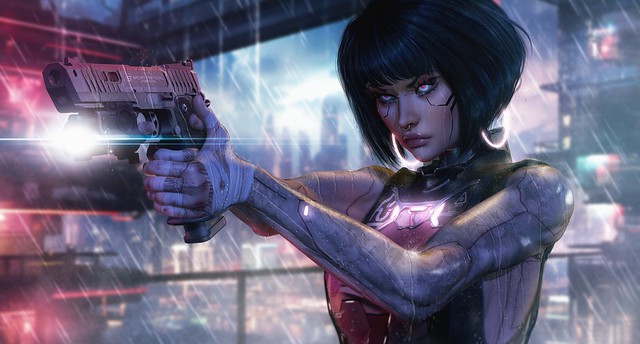
Cajsa Lilliehook covers the best in virtual world screenshot art and digital painting
Vi Takeda calls herself a “Style Chameleon” and a more perfect description can not be found. Her avatar has been through the wars, her hands bloody and bandaged with spider veins on her arms. It’s pouring rain, but she’s still determined and taking no prisoners. Her face says it all. They will regret making her mad.
For more from the avatar-based Style Chameleon, click here:
-
Everyone in tech is seemingly psyched for the latest update of Chat GPT4o — mainly for its genuinely impressive version of the AI from the movie Her (watch below) — but for the record, it's still having trouble with at least one obvious question: What's my definition of the Metaverse?
Ask GPT4o that, and you get this farrago of flim flam:
Wagner James Au defines the Metaverse as a collective virtual shared space that combines virtually enhanced physical reality with persistent virtual reality. He sees it as an interconnected network of 3D spaces where users can interact with each other and the environment in real-time. The Metaverse is not just one platform but a convergence of various virtual worlds and augmented reality experiences, creating a seamless digital and physical blend.
Again, what I actually wrote on this blog years ago, and in several online articles in major news sites, and in the very opening page of my latest book, is this:
The Metaverse is a vast, immersive virtual world simultaneously accessible by millions of users through VR and other devices, highly customizable avatars and powerful experience creation tools. It is integrated with the real world economy and compatible with external technology.
Instead of outputting that, however, GPT4o insists on ascribing what others have written, then duct tapes it onto what I've quoted others having said. (Along with the usual hallucinations — WTF is even "a seamless digital and physical blend".)
"I can see where it's picking up some of this stuff," my friend Adam Frisby, who ran the GPT4o query for me, surmises. "You're talking about other people and what they're doing, and ChatGPT is basically transposing you commenting as your personal opinion."
The fundamental problem, he suggests, is happening on a deep epistemic level:
-
I'm preparing to write an in-depth report on the internal user-driven Second Life economy, which remains one of the most thriving in the entire industry. (And arguably better than even Roblox.) As part of that, I'll be conducting an anonymous survey of SL-based content creators, trying to capture the overall state of the market, while offering some useful takeaways for creators.
What questions should I ask? Here's some I have in my notepad:
How long have you been creating and selling content in SL?
How much in USD do you gross per year?
What price is your best selling item?
What percent of your sales are from the Marketplace?
How has your income from Second Life creations/merchandise evolved over the past few years?
Are you actively preparing to sell your content to mobile users?
Are you also selling your content on other platforms, and if so which ones?
Please post more in Comments below, and share this open forum post with the SL content creator in your life!
 Wagner James Au / New World Notes