Linden Lab just announced some pretty big updates to its Second Life mobile app (watch above, featuring a celebrity cameo) chief among them being these:
Voice chat is now available in mobile on an experimental basis in some regions
Mobile access is now expanded to all subscribers levels, including Plus (i.e. $5.50/month)
The announcement goes into detail on how all areas of Second Life are accessible, regardless of content rating — something I discussed a few weeks ago:
Cajsa Lilliehook covers the best in virtual world screenshot art and digital painting
Niely Atheria has a wonderful stream of historical cosplay pictures like “Fairytales Dream” above. The prince chasing Cinderella looks like he has a chance of catching her, though. I love the ornate carriage almost out of the frame, but you can see how fancy it is. The dress is also exquisite. I love that it’s not too frilly, just gorgeous.
It's impossible to understand US politics or Internet/gaming/virtual world culture without knowing about Gamergate, the numerically small but highly coordinated online harassment campaign unleashed almost exactly 10 years ago. Fortunately there's a new oral history on the topic: The Hivemind Swarmed by David Wolinsky, and the book's summary puts it well:
Gamergate holds the grim distinction of being the first modern online harassment campaign. It arguably served as a model for the alt-right movement that would help propel Donald Trump to the White House. And it highlighted a toxic media culture—not just in gaming, but in film, TV, journalism, and more—in which leaders, through their passivity, took the side of the oppressor. Now, 10 years later—in the wake of #MeToo, Charlottesville, the Trump years, and the January 6 insurrection—the questions discussed here are more important than ever.
I was honored to be one of the many people David interviewed for the book, a highly readable and engrossing first-person account of that period, and what we've (hopefully) learned since then. Thanks to him and his publisher, New World Notes is featuring a lengthy excerpt (below) and a special discount code:
Here's the excerpt, featuring indy pop star Jonathan Coulton, journalist Clive Thompson, virtual world pioneer Richard Bartle, and others (including, well, me, very briefly piping up here):
Cajsa Lilliehook covers the best in virtual world screenshot art and digital painting
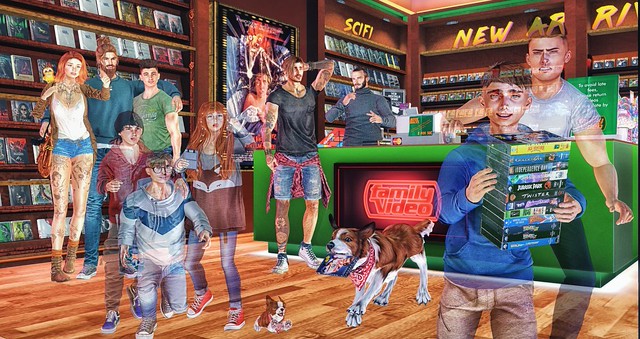
Brian Werefox created this fabulously imaginative picture picturing himself back in earlier years, called “I wish that we could go back in time to those days that made us who we are.” It was taken at Mall Paradise, a place that must have reminded him of the thrill of renting a movie back when videotapes were new. I do remember how my friends and I would wander the aisles trying to pick a movie. Maybe when it is as easy as clicking a button online, the thrill is not so great, especially since Netflix won’t run out of copies. That reminded me that there is still one last remaining Blockbuster and it’s here in Oregon. There’s even a movie about it.
Speaking of "primitives", that's the name for a new $2/month tier on my Patreon — perfect for people who just want to support New World Notes and get early/exclusive feature length articles, along with other special benefits. (The Creator and Partner levels are designed for readers interested in actively promoting their virtual brand/content.) Go here to check out all the tiers and benefits.
Important fact check from longtime reader Joey1058, on my rant about Zuckerberg talking about adding "primitives" to Horizon Worlds, a term I suspected he lifted wholesale from Second Life:
I hate to be the bearer of bad news, but 'primitives' isn't new to SL either. We'd been using prims in VRML for half a dozen years before SL left the lab.
Joey is right — pictured above are primitives from VRML, the early 3D web coding language from the 90s, as noted here:
Cajsa Lilliehook covers the best in virtual world screenshot art and digital painting
Jasminlu Breil not only blogs high fashion in her Flickr microblog, she does it with verve situating her avatar in venues that make sense with her clothing. I mean, how often do people get to wear sexy, sinuous gowns like this? But a singer? Then the clothing makes sense. She’s probably a torch singer.
When I first saw these new shoes by Second Life creator Hanna Lindberg, I had to lightly gasp. After she had told me how she made them, I had gasped several times more.
The first story of these shoes, you can discern by looking close. Among her first creations using PBR lighting, the detail in the shadowing and reflection, evident down to the fine texture of the leather, is amazing. Since Linden Lab launched physically based rendering to Second Life last Summer, content creators have been frantically working to update their product line with PBR to stay ahead of the competition. The market for avatar fashion is massive across numerous platforms, and dominates the Second Life economy in particular. (And not just clothing items like shoes: A creator of customized virtual feet, for instance, earns six figures a year.)
To modernize her mesh-making skills to create in PBR, Hanna watched tutorials like these. It took her 1-2 days to understand the basics.
"Starting to learn something new and unusual is always difficult and scary," as she puts it to me.
So that's one story about the Second Life shoes of Hanna Lindberg.
Courtesy the eagle eye and video capture skills of Rhiannon from Avacon, here's Zuckerberg at this week's MetaConnect announcing "improved" avatars and HTML-like building blocks for the Metaverse, which he calls… "primitives".
Someone should write a book about this one sentence!
Nick Yee and his QuanticFoundry firm, by the way, about 1 in 3 men prefer to play as female avatars. (With about 1 in 10 females choosing male avatars.)
Why did Meta design avatars to look like their real life owner, when 1 in 3 males don’t even want avatars that share their real life gender?
As we’ll explore in later chapters, the popularity of non-realistic avatars reflects the internal motivations of people who most enjoy metaverse platforms — especially the very young, who comprise their core user base: They are in virtual worlds where they can explore and create and experiment with identity, which they are still developing and in their own lives.
As for "primitives", that's been a core term for building blocks in Second Life for over 20 years*. But then again, Zuckerberg probably heard the term in a Facebook presentation.. from founding CTO Cory Ondrejka:


 Wagner James Au / New World Notes